


The past month has seen a flurry of blows from DC rain down upon the Chinese AI industry. In early November, Oracle abandoned a $7 billion deal with Tencent under pressure from Washington. Then the US Bureau of Industry and Security (BIS) tightened the rules on advanced chips. The DC establishment is gearing up to de-facto ban Chinese open models (as I predicted in June), and the era of distillation is over.
This summer and fall I was in Beijing, and many of the most brilliant researchers I know there were resigned to becoming “generic pharmaceutical makers”. They understood their role to be one where they worked hard to optimize pretraining while most of the rest of the innovation needed to produce SoTA models was outsourced to the West.
These blows landed heavily in China. Nobody wants to spend 12 years of their lives studying ML to produce the latent spatial equivalent of knockoff Ozempic. The brilliance of the Chinese ecosystem is undeniable, but a lack of capital and a lack of GPUs meant that competition drove the labs to pursue strategies that broke terms of service instead of breaking new ground in research.
Some sixty days from this low point, the vibes in Haidian are changing quickly. Labs on death ground are not content to just follow this old path; they see that their survival is dependent on more radical thinking, bolder bets, and cutting dependence on the American AI stack.
Chinese labs are now focused on asymmetric competition, becoming ungovernable by DC, and fighting to reach the frontier. Hope has sprung from death ground.
the year ahead
The path forward for Chinese labs will depend on four key pillars:
progress without compute efficiency advantage
avoid relinquishing the Chinese internet to AI
leverage state capacity
prioritize ruthless efficiency built on lessons from the West
progress without compute efficiency advantage
The last three years of Chinese AI progress were built on a simple idea- you can keep up with the West with 10% of the compute if you’re 10x more efficient in your deployment of that compute. Much of that efficiency came from distillation, training on the answers of American models, or as I put it in June, drinking Claude’s milkshake. The last three months have killed that paradigm; now the labs must progress without a compute efficiency advantage, through asymmetric bets on the many unexplored paths of ML. Generic pharmacology is dead, and the new direction looks very different:
MiniMax is betting on math and has made progress on breaking encryption
Zhipu is betting on loop transformers (they released a model yesterday!), and RSI
Tencent is betting on safety, with an impeccable model card and report
MiMo is betting on radical transparency in RL & ecosystem leverage
DeepSeek is betting on harness development
Kimi & others are doing cool but unannounced asymmetric bets
miHoYo and others will emerge as dark horses
avoid relinquishing the Chinese internet to AI
It seems obvious to me that the West has implicitly decided to relinquish our internet to AI. We are not the native species of the web, and if we’re not already a niche part of the ecosystem we will be soon.
The situation in China is quite different; their internet, built on a very different set of technologies and values, cannot survive the AI transition in its current form. The walled gardens of the Chinese internet (accounts are tied to a real name through a phone number and a government ID) will have to stay governed and controlled by state and corporate forces, or will risk destruction.
Dan Wang wrote a very compelling op-ed yesterday in the NYT on just how this conflict could play out; I believe that the crackdown he mentions will not fall on the AI companies, but instead on the platforms that run much of China’s internet. The government will abandon the idea of policing AI beyond the borders of the biggest tech companies, and will instead obsess over the security of these walled gardens and their own state infrastructure.
The walled gardens of the Chinese internet (Weibo, WeChat, Alibaba, Xiaohongshu) will all be resistant to AI agents, both from a cybersecurity standpoint and also from a content standpoint. They will remain controlled by the state, and while they will be full of AI, that AI will be strictly controlled. The open internet will be mostly wild and without controls, and run by AI.
I see this starting as an embarrassing incident like the swarm of agents my friend Ethan found this fall, but they’re doing something more malicious like scams on WeChat. Beijing closely works with the platform companies responsible for what people post, and that is extended to agents using these platforms. Similar to how ByteDance shipped a phone with an assistant that was immediately banned from WeChat and other apps, China’s agentic web will be forced to grow outside of these “walled gardens” or else have a registered identity and a responsible human. The platform companies will have their own agent be the only one able to work within the walled garden, and the Cyberspace Administration of China (CAC) will fine anyone letting “unregistered” agents operate in these gardens. ByteDance made the point for me today; its new assistant Xiaodou acts inside ByteDance’s ecosystem.
This may result in a Chinese agentic economy that is significantly less effective and much more siloed than the West (think payments inside WeChat Pay, or shops that exist only as mini programs), but it also will undoubtedly create more security and control inside China’s digital walled gardens. It is foolish to think anyone knows how to “best” build an agentic web, so the decisions here may be correct when the dust settles.
leverage state capacity
The US has shown the power of the Executive branch through the latest export controls, the Second Coming of Jensen, and the coming crackdown on corporate America’s use of Chinese models. China will respond to this flexing of the Executive muscle with their own show of state capacity; the form of which is gradually becoming clear.
Having opened with Sun Tzu, I cannot indulge in further China cliché, as tempting as the “100 year plan” claptrap may be. The West has long fantasized through things like AI 2027 that China will wake up to AGI and centralize all efforts in a state program; I doubt this very much.
The labs are now in a position where some key priorities of their business operations conflict with the state’s stated stances. Beijing wants to limit the import of lesser NVIDIA chips like the H200 that compete directly with domestic Ascend chips, while allowing the labs access to rented Blackwells in other countries.
As important as compute is, that is not the whole game. The Chinese state will in time muster all its might and resources to help the labs succeed; datacenter buildouts, data access and labelling, talent pipelines from top university programs right into the lab teams that need it most, and the convenience of municipal champions for more simple needs like real estate and permits (the new Zhipu building in Beijing is stunning, and is perfectly situated so that one can peer into the Tsinghua campus that birthed the company, allowing the founder to make a quick commute to a class he still teaches on Tuesday nights). On data, Beijing set up the National Data Group in Xiong’an in October, a state-owned company backed by Big Red Telecom and the power grid operators, to wrangle China’s data into a form fit for model ingestion.
The most successful labs in 2027 will leverage state capacity to further their own goals and avoid conflicting with the goals the state has made explicit; notably, safety, domestic AI independence, and the export of a “sovereign AI stack” to the world.
prioritize ruthless efficiency built on lessons from the West
It is not possible to walk down the street in SF these days without an ambitious Zoomer attempting to sell you an RL environment; this chaotic jumble of companies and approaches is now roaring into Haidian in the post-distillation era. There is great reporting from ChinaTalk on how some Western data providers have been ramping up their work with China.
That will not be enough: no lab on death ground will hand its post-training to costly Western suppliers Washington can switch off. The Chinese data industry must 10x in 12 months to meet the needs of their labs. The native ecosystem will be built more carefully, using lessons gleaned from SF on how to scale post-training inputs efficiently. The current winners inside of China are all raising ambitious rounds that will be announced before Chinese New Year, and at least one is deep in talks with a Chinese hyperscaler about buying the company (something rare in the Chinese AI landscape).
This frenetic pressure will lead Chinese labs away from reliance on the West for post-training inputs, and into their native ecosystem’s own strength when it comes to data. New data will come from new data companies making it. As someone interested in model character, I also believe this will radically alter the feeling of Chinese models, something I will be watching with great interest.
armchair prognostications
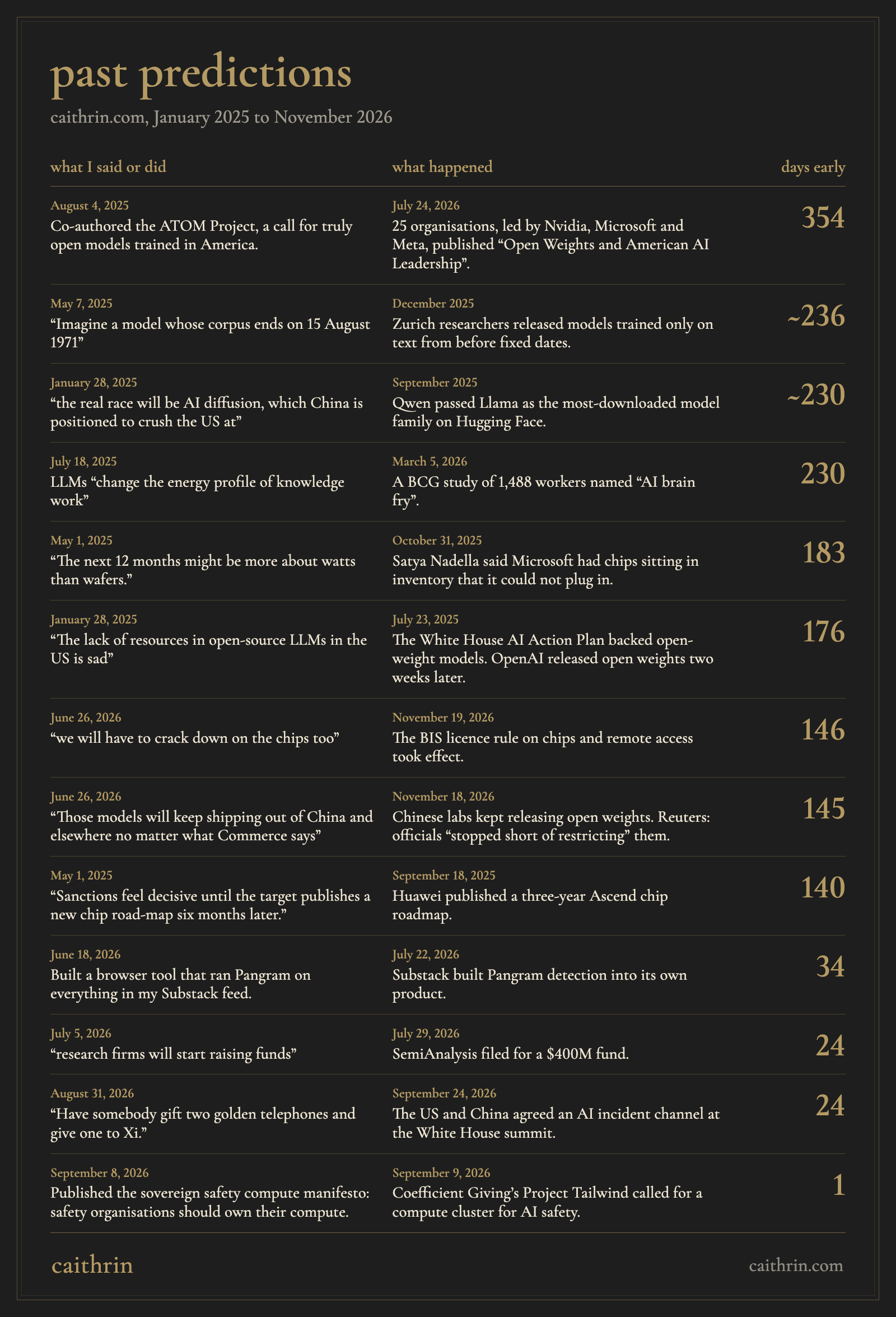
I enjoy predictions, because I am in the enviable position of being close enough to what I care about to be accurate but insignificant enough that nobody teases me when I get things wrong. If anyone wants to make markets for these predictions, message me and I’ll put up some small cash in support of my positions.
predictions, part one: government
Here are my best predictions for Chinese AI in 2027- built from these 4 pillars, here is how I believe the coming year will play out.
US foreign policy
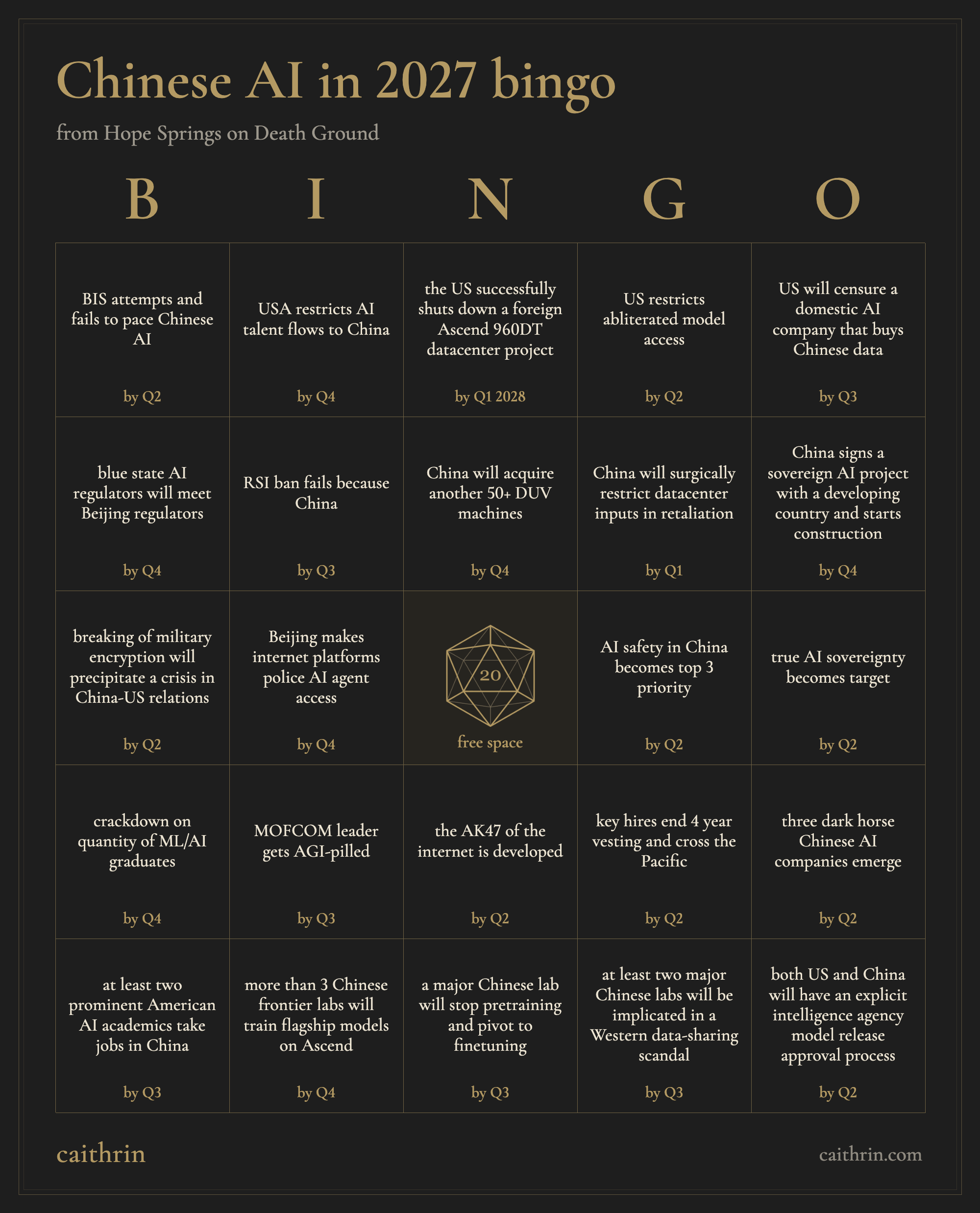
BIS attempts and fails to pace Chinese AI by Q2
Washington will offer Beijing access to chips in exchange for slowing frontier model releases. I expect Beijing to keep withholding large-scale import approval and pushing labs away from the US stack. Beijing can withhold import approval while Chinese labs seek licenses to rent Nvidia chips overseas. On November 5, Reuters reported that two sources estimated roughly 600,000 H200s were waiting in Hong Kong. Some shipments had already entered mainland China. Team America, World Token Police will not survive Jensen’s return to the helm of Big Green.
USA restricts AI talent flows to China by Q4
With the end of the distillation paradigm, the value of lab talent from OpenAI and Anthropic in China will convince some researchers to move. This will trigger a response from DC eerily similar to the Manus fight. Beijing wouldn’t let Manus leave; DC won’t let its researchers leave.
the US successfully shuts down a foreign Ascend 960DT datacenter project by Q1 2028
A middle power like Malaysia will attempt to build a datacenter with Huawei chips and the US will intervene successfully to push them to buy from an American supplier. This will become a popular method of securing allocation from NVIDIA and others.
US domestic policy with Chinese implications
US restricts abliterated model access by Q2
Banning abliterated open models (models whose weights have been edited to strip out their safeguards) will be a first step in banning Chinese AI domestically. The current ease of access will be restricted, and Jensen now owing his job to Trump will mean that Hugging Face will go along with it. The Hugging Face founders will fight a losing battle in the US courts on this.
Abliterated models will be like CP; you can’t get rid of them from the internet, but you can make a cocktail of social censure, criminal penalties and difficulty downloading to make sure they are a dark fringe of the web.
US will censure a domestic AI company that buys Chinese data by Q3
As the Chinese data industry explodes in funding and becomes fiercely competitive, there will be significant savings for US model makers to buy from China. This will be revealed by a western journalist and will create a hurricane of paranoia in Washington.
blue state AI regulators will meet Beijing regulators by Q4
The US will see dramatic action on AI regulation, most notably from California. There will be a bilateral between California and China on AI regulation, and both sides will use it as a springboard for more AI safety talks at higher levels. State, municipal or sector-level agreements will produce actual coordination on audits and model releases. California and Beijing have already signed a climate agreement.
RSI ban fails because China by Q3
California has proposed giving regulators authority to limit recursive self-improvement. The threat of China winning the race to AGI will ultimately doom an RSI ban in the US.
Chinese foreign policy
China will acquire another 50+ DUV machines by Q4
There will be a race to acquire foreign-made DUV machines in China, even as the state doubles down on their indigenous ecosystem tooling.
China will surgically restrict datacenter inputs in retaliation by Q1
China will restrict some key technologies for the US datacenter buildout in response to the new BIS rules, but stop well short of serious responses as their AI companies will be using US datacenters extensively for their inference needs. Companies that rent to Chinese firms will have an easier time getting components, but this won’t become public knowledge until Q4.
China signs a sovereign AI project with a developing country and starts construction by Q4
By Q4, China and a developing country will have signed a deal for a locally fine-tuned Chinese model, safety testing, an Ascend datacenter and renewable power. Construction will have started. Beijing will hold it up as a Belt and Road success story. China has already pledged AI infrastructure and capacity-building support to developing countries.
breaking of military encryption will precipitate a crisis in China-US relations by Q2
The US and China will both hillclimb math enough to break low-level military encryption in Q1, which will result in a period of some weeks of scary headlines before solutions are found.
Chinese domestic policy
Beijing makes internet platforms police AI agent access by Q4
By Q4, Chinese regulators will require major platforms such as WeChat to identify third-party AI agents and block agents that operate without permission. Today, platforms already restrict some agents on their own.
AI safety in China becomes top 3 priority by Q2
Chinese labs will be recognized internationally as leaders in model safety techniques, even as they stay open weight. Western labs and regulators adopt Chinese evals, safety practices and other ideas that the Chinese government also sees as key initiatives. One example to watch is the independent testing done for Tencent’s Hy4 release by Fangcun AI and Alice. I’ll also be watching how well models hold their safety behavior under pressure when the right answer depends on context. OpenAI calls this fuzzy robustness.
true AI sovereignty becomes target by Q2
The lesson of this latest BIS ruling is that there is no amount of frontier competition that DC will tolerate in AI. The Chinese state will explicitly announce plans for a sovereign AI stack that will have the full backing of the Chinese state, even while they accept that NVIDIA chips are needed in the short term.
crackdown on quantity of ML/AI graduates by Q4
The state will restrict the number of AI-related undergraduate positions available, and crack down on dozens of “learn to be an AI expert” education outfits operating in China. The state will attempt to rebalance the education system to avoid 25 million kids competing for 50,000 lab jobs.
MOFCOM leader gets AGI-pilled by Q3
Radical efficiency gains by AI create a sudden explosion of interest in AGI by China’s Ministry of Commerce (MOFCOM), and the leader Wang Wentao joins fellow Fudan alumnus Wang Huning in pushing AGI preparation into government plans domestically. He makes a series of notable AGI remarks and is seen as China’s first AGI believer among Xi’s inner circle.
predictions, part two: industry
the AK47 of the internet is developed by Q2
We see the release of a sub-200B open weight model with an accompanying harness that becomes the ubiquitous tool of cybercrime. This model/harness combo makes it trivial to commit crimes and acts of malice online, similar to the AK, and over the next 24 months it is copied at least 1 million times. The skill floor for its use is so low that anyone can use it.
key hires end 4 year vesting and cross the Pacific by Q2
The Chinese and American hires that joined labs right after the ChatGPT moment from both countries end their 4 year vesting and cross the Pacific. Major announcements come fast and furious, and become very political.
three dark horse Chinese AI companies emerge by Q2
miHoYo and Pragmatik Labs (alongside a third effort supported by Chinese hyperscalers) drop important releases.
industry predictions, lightning round
At least two prominent American AI academics take jobs in China by Q3.
Ascend 960DT will ship in volume by Q4.
More than 3 Chinese frontier labs will train flagship models on Ascend by Q4.
Chinese data industry will 7x VC investment by Q1 2028.
Huali or another player will ship a non-Huawei AI chip in volume by Q4.
Chinese labs will move training to new Vietnam, Brunei & Laos clusters by Q3.
A major Chinese lab will stop pretraining and pivot to finetuning by Q3.
By Q1 2028, Chinese labs will use more compute for frontier training on Chinese-designed accelerators inside China than on chips rented offshore.
At least two major Chinese labs will be implicated in a Western data-sharing scandal by Q3.
Chinese AI safety orgs will have offices in the US by Q4.
Both US and China will have an explicit intelligence agency model release approval process by Q2.
eating bitter, lesson
So much of the coming year depends upon compute, and a great deal of these predictions revolve around access to a threshold of FLOPs that allow China to stay relevant. The world of export controls is changing fast, and the White House must navigate a narrow path that protects both the strategic advantages of American AI and the delicate supply chains of that same industry. Ultimately, DC negotiates with a China led by educated, rational technocrats in government and earnest lovers of open source in industry. The relationship is not so difficult.
As we enter deeper into what Demis called “the foothills of the singularity” we must not forget to seek allies in unlikely places. China owes much to American innovation, and America’s AI companies would be half-empty if not for China’s talent, dedication and work ethic.
On safety, I see hope everywhere I look: Fangcun and Tencent, the recent profile from SCMP of Concordia, and the optimism of the labs on the paths forward. China will further develop safety techniques that will help move the industry forward, and even as models will do terrible damage to our beloved internet in 2027, the seeds of safe, responsible AI are growing.
Washington must consider carefully if they want to fight Chinese industry on death ground, and if they want to compete with Beijing on state capacity. The hope I see in Beijing this month is driven by the same spirit of innovation that got American AI through the long dark period where GPUs were anemic and funding scarce; we must be careful not to provide China with excuses to build a sovereign stack of autarkic AI.
Thank you for your time and attention as a reader- reach out to me anytime if you have comments or questions. To read my work in AI Safety, visit pacificcompute.org.
several data-purchasing heads and investors did the sum for z finance, and the whole chinese industry’s budget for RL environments and expert data this year came out between one and two billion yuan. none of them are named, so treat it as a rough size. the piece says people in the trade expect more than 10 billion next year, so 10x would be the top of that range.