

choke points
In the twilight days of the Second World War, a man named Vannevar Bush handed the President a short report on how technology would be advanced in the post-war era. Bush was a great American, an MIT engineer who spent the war running American science. He oversaw the work that produced radar, the proximity fuze, and the first months of the atomic bomb. Greater minds than mine have called him the man who won the war for the Allies.
Roosevelt’s sleeping giant did not slumber when the Russians took Berlin. The innovation machine built to defeat the Axis ran on through peacetime, a mighty bureaucratic engine that turned money into physics, hardware, and frontier science. America got the best deal in the history of civilian-military fusion: the state would forge technologies for the sword, and then, when it was ready, hand over the ploughshare.
Here is what Vannevar got you:
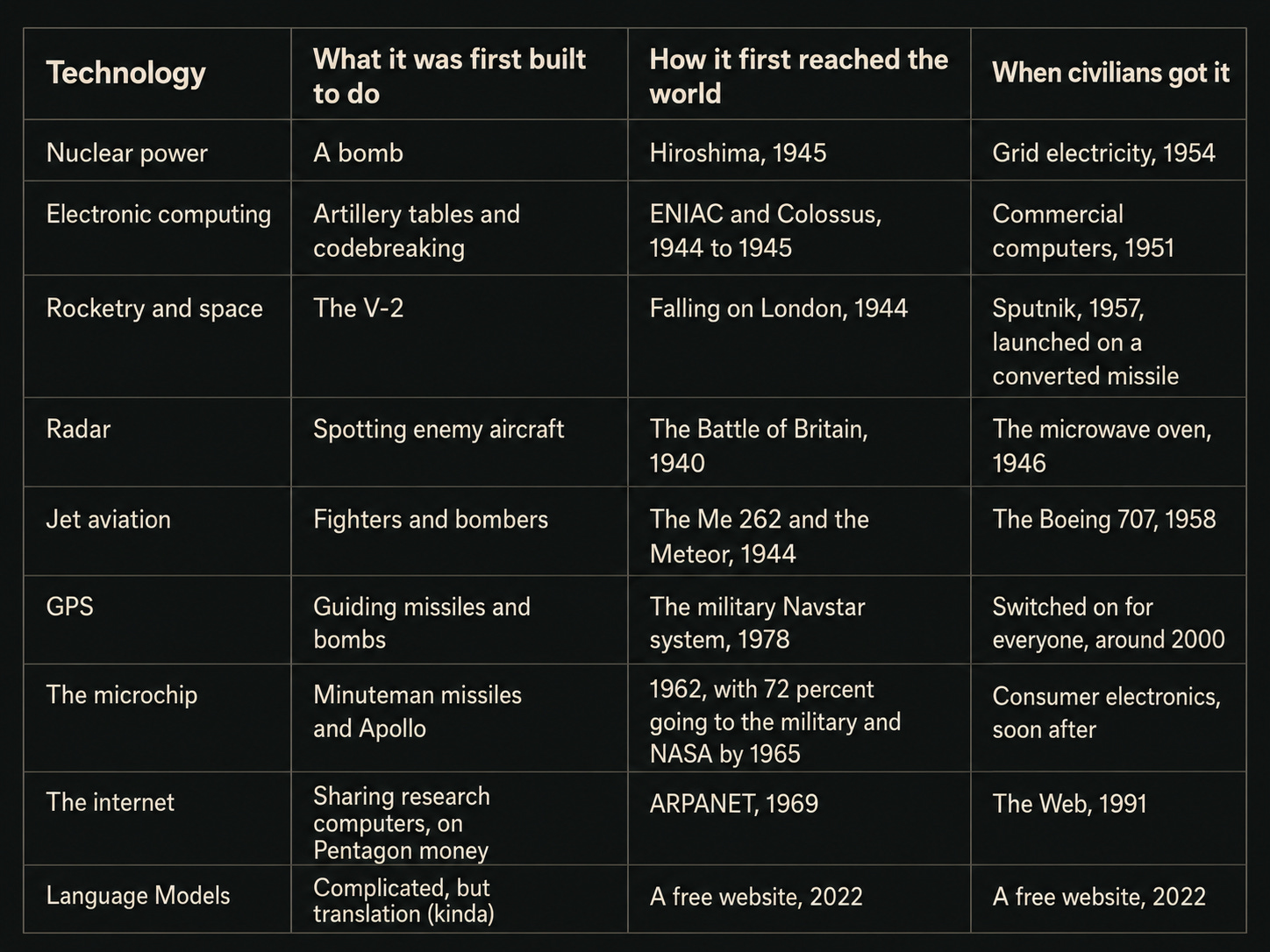
From 1945 to 2015, almost every significant technology was invented by and for the state, and only allowed into civilian life on the government’s terms and in the government’s time. This is the grand bargain Vannevar struck: we will build the most enduring innovation machine the world has ever seen, and it will give you untold riches and prosperity. GPS will spend two decades as a military signal and then it will drive your car. Semiconductors will drop precision bombs on bridges in Vietnam and then they will power a revolution. The state will make us exquisite swords, and then exquisite ploughshares.
Until LLMs.
a medium-sized customer
The American government has recently told Anthropic to switch off its two best models, Fable 5 and Mythos 5, for every foreigner on Earth. It has asked OpenAI to release its next model the same slow, methodical way, to a short list of trusted partners, with the government approving access customer by customer through the preview window.
The American government is now in the unenviable position of watching the Vannevar Bush pact break over an innovation that was used for peace before war. Language models have some grounding in military-civilian fusion technologies like the internet and GPS, but their creation did not come from military money or government support. It came from the slow, patient work of distinguished scientists from a dozen countries, working in the open, collaboratively, to build a ploughshare.
For ten years deep learning resisted militarization. We got Swedish YouTubers fine-tuning language models before we got a Claudeowitz. It is extraordinary to me that the state took as long as it did to assert itself in AI beyond export controls, and I think that is not only an indictment of American state capacity in this moment but also a story about economics.
The internet, DARPA’s greatest gift to humanity, was born in a military context and produced a generation of companies so rich they could supplant the spending power of the state, and in doing so they supplanted Vannevar’s pact. In the 1960s the federal government funded about two-thirds of all American R&D. Today it funds a fifth, and private business funds three-quarters. This is both a retreat from the frontier by the state and a symptom of its success. This year the four largest American tech firms will spend half a trillion dollars on AI infrastructure, more than the entire federal research budget, military and civilian combined. A government that once concentrated a whole nation’s resources into a Manhattan Project or an Apollo mission is now a medium-sized customer with a monopoly on violence.
So for a few years the most important technology in the world sat outside the state’s control. A system whose whole organizing principle is control does not leave an anomaly like that alone forever.
the anomaly
You could tell yourself this was a domestic story. The frontier had moved from Washington to a few campuses in sunny California, but it was still American, still ours, still comfortably inside the country’s nexus of control.
That story has changed. The share of global traffic going to open-weight models out of China went from a rounding error at the end of 2024 to something like the majority of all tokens by the middle of this year. Downloads tell the same story: Chinese open models went from low single digits to roughly a third of the world’s in about a year. By one Congressional estimate, something like four in five American AI startups are now building on Chinese open weights, export controls be damned.
The frontier left the government for the private sector, and Vannevar’s pact broke. Now the center of gravity, the question of whose models the world actually runs, is sliding offshore, onto open models the United States cannot switch off and increasingly cannot even run on chips it makes itself.
This is what happens when you rent the frontier of technology instead of owning it.
renting the frontier of technology
The death blow to Vannevar’s pact was an admission, during the Obama years, that the United States could rent the frontier of science instead of owning it. It was a long time coming. A man named Ashton Carter predicted it in a 1992 book, and the admission finally arrived in 2015, when the same Carter, by then Secretary of Defense, flew to Palo Alto and gave a slightly goaded speech about how the Pentagon was going to have to learn to buy commercial technology.
The speech is worth quoting. “When I began my career,” Carter told the room in the 2015 Drell Lecture at Stanford, “most technology of consequence originated in the United States, and much of that was sponsored by the government. Now much more technology is commercial, and the technology base is global.” The whole talk was a plea to rebuild the bridge between the Pentagon and Silicon Valley, and he was honest about which way the traffic now ran.
The technologies he wanted most, the ones his own DARPA had seeded in their infancy, the voice assistant and the self-driving car, had grown up and moved out. He would have to get in line and buy them back, humbly, like everyone else.
This was echoed by the national commission chaired by Eric Schmidt, which reported to Congress in 2021 that AI progress should mostly stay within the American private sector and its universities.
The state, in those years, made its peace with the broken pact and settled for renting the frontier of technology.
Enter Trump, Hegseth, and the gang.
Vannevar Cargo Cult
The last three weeks of this month are the state deciding that renting the frontier is no longer acceptable. On June 2nd an executive order created a category called Covered Frontier Models and asked the labs to give the government up to thirty days with a model before the public gets it, with the NSA and CISA standing up a classified process to decide which models qualify. It may be voluntary for now, but Anthropic’s blacklisting from the Department of War shows the price of saying no. Then Commerce reached for a harder tool, the export-control authority built for missile parts and centrifuge blueprints, pointed it at a model, and revoked access for every foreign national in the world. And this week, only trusted partners may touch OpenAI’s newest model. The frontier, once made in the open and pinned to a poster board at NeurIPS, has moved from the back rooms of closed labs to the back rooms of Washington.
This is not a return to Vannevar Bush’s sixty-year push for the government to own the machinery of American innovation. It is a curious cargo cult of that era. Without restoring the state-led innovation machine to anything like its old glory, we will build a facsimile of it out of control over our partners. I argued last August that the government’s 10 percent stake in Intel should worry the frontier labs; this new move should surprise nobody.
The new paradigm will look a lot like Atoms for Peace. We remember that as Eisenhower’s great generosity to the United Nations: he offered allies nuclear power, the reactors and the fuel and the know-how, on a single condition, that the United States remain at the center of it, the holder and the dispenser, so that no friendly country ever felt the need to go and build its own.
It was a cunning move by a brilliant man, controlled diffusion by the one nation that actually held the bomb, engineered to keep the center of power sitting exactly in America’s lap. Those allies were trusted partners, and that same speech, seventy-three years on, could be given about language models today, dispensing metered access to the frontier so that allies do not wander off and come to depend on someone else’s. This technology, however, was not invented by the state. It was no child of Vannevar, but a product of American enterprise and global talent, and so the age of the Vannevar cargo cult begins.
restraints on Claudeowitz
The Vannevar cargo cult will take tools built by open science across a dozen nations and try to choke-point them, reaching for the same apparatus of restraint we built around the atomic bomb.
You go looking for the uranium, you embargo it, you sign treaties about it, and you snoop on your neighbours to work out who is enriching and who is not.
You keep the list of holders short and you lose sleep over them one at a time.
You stand up whole divisions of your intelligence services to make sure that the ones who do have the bomb, the ones you wish did not, like Pakistan, never hand it to someone worse.
The whole system rests on a single fact: the exquisite weapons the Vannevar pact produced were scarce.
Language models are not scarce. They are one of the most abundant technologies ever built. I do not think there is a single nation on Earth that could not, with a few months and modest resources, stand up the current open-weight frontier as a sovereign AI project. Those models will keep shipping out of China and elsewhere no matter what Commerce says, and adapting them for war is the precise inverse of Atoms for Peace. The technology is diffuse, ungovernable, and already loose. Putting it back in the bottle, with America as the controlling shareholder of its development, is an impossible job.
When Commerce switches Fable 5 off for the world, what has it actually denied anyone? The capability did not vanish. The people who trained that model, many of them not American, did not suddenly discover a burning need to reconcile with the military-industrial complex. Export controls were never going to stop China from training a Fable of its own. When Elon Musk guessed on X that a Chinese lab would not pull it off until probably the first quarter of next year, Tang Jie, the Tsinghua professor behind Zhipu and its GLM models, replied that it would not take that long. He was not bluffing. Zhipu had already trained a frontier model on roughly a hundred thousand Huawei Ascend chips, without a single NVIDIA among them, and shipped it to the world on OpenRouter under a license that lets anyone do as they please.
Those government efforts to seize control of this technology might feel, to the people making them, like a return to the triumphant days of the Vannevar pact. They are nothing of the sort. They are cargo cult: the men cannot and will not control this the way they want to. It is a figure on a tarmac, waving paddles of straw and bamboo at planes that are landing somewhere else now. The classifications, the embargoes, the rationing, all of it performed beautifully and skillfully by bureaucrats in Washington, will amount to almost nothing, because the monopoly that once made those gestures enforceable, the one Eisenhower held, has been broken and will not return.
the coming weeks
The new default posture of American frontier intelligence is invite-only. Every time we wall off an American model, we hand another month of momentum to the open ecosystem, so the cargo cult will have to come for that ecosystem too.
Open models will be rules-lawyered into a de-facto ban in the United States. Their development will be folded into the same closed paradigm the frontier labs already offer, and Chinese models will be cast as intellectual-property theft rather than genuine innovation.
And without tanking Nvidia’s market cap, we will have to crack down on the chips too. The hardware choke point is the one place the old physics still applies, and it is the narrow path by which the Vannevar pact might genuinely be renewed, because the chip is the only part of this technology that is truly a product of American government largesse. The extreme-ultraviolet lithography that makes an advanced chip possible was not conjured by ASML alone. Its foundations were laid in the 1990s by Lawrence Livermore on Department of Energy money. ASML, a Dutch company, was only permitted to license that taxpayer-funded research after Congress signed off, and only once it agreed to open a US research center and source more than half the components of its American-sold machines from American suppliers. The same is true of the security the United States extends to Taiwan and its fabs. The frontier of the chip really was a gift of the state.
The era when Eisenhower could choose where and when to share the atom is going to return, but it will arrive into a starker reality: a technology that needs no embargoable input, and a rival of comparable economic and global weight, China, making free and open models for the whole world.
Every time America throws that switch and cuts the world off from frontier intelligence, the world will notice. And eventually the planes will stop landing in San Francisco.
sources & notes (AI generated)
Vannevar Bush and the bargain
- Vannevar Bush, Science, The Endless Frontier (1945) — nsf.gov
- The dual-use table draws on standard histories: Chris Miller, Chip War (2022) for the ~72% military/NASA share of mid-1960s chip sales; IEEE Spectrum, “From World War II Radar to Microwave Popcorn” for the magnetron-to-microwave story; NASA on Sputnik flying atop a converted R-7 ICBM. GPS civilian accuracy: Selective Availability switched off May 2, 2000.
The economics of the broken pact
- Federal vs. private R&D share (≈two-thirds in 1964 → ~18% in 2022, business ~75%): NSF NCSES, National Patterns of R&D Resources.
- Four largest tech firms’ ~$500B AI infrastructure spend in 2026: CNBC, Feb 2026.
Renting the frontier (Carter → NSCAI)
- Ashton Carter et al., Beyond Spinoff: Military and Commercial Technologies in a Changing World (Harvard Business School Press, 1992).
- Ashton Carter, Drell Lecture, Stanford, April 23, 2015 (the “most technology of consequence originated… with the government” quote). (Video: https://www.youtube.com/watch?v=PNhT3aIsLgU)
- NSCAI Final Report, March 2021 (Schmidt commission, “most AI progress… should remain with the private sector and universities”).
The offshore shift
- US-China Economic and Security Review Commission, Two Loops: How China’s Open AI Strategy Reinforces Its Industrial Dominance (March 2026) — the ~80% of US AI startups on Chinese open models [PDF].
- Center-of-gravity / OpenRouter token share: The New Stack; Data Gravity, “China’s Open-Weight Takeover.” (Secondary aggregator data; treat the majority-of-tokens figure as approximate.)
The June 2026 control cluster
- Executive Order 14409, Promoting Advanced Artificial Intelligence Innovation and Security, June 2, 2026 — White House; plain-English summary, WilmerHale.
- Commerce/BIS suspension of Fable 5 and Mythos 5 (June 12, 2026): CSIS analysis; IAPP; Tech Policy Press.
- G7 “trusted partners” access (June 16–17, 2026, Évian): The Japan Times.
- OpenAI asked to stagger its next model (June 26, 2026): The Next Web. Precedent: OpenAI, “Introducing Trusted Access for Cyber”.
Atoms for Peace
- Dwight D. Eisenhower, “Atoms for Peace,” UN General Assembly, December 8, 1953 — IAEA.
Tang Jie / Zhipu on Huawei silicon
- The exchange: Tang Jie (@jietang) on X, replying to Elon Musk.
- GLM trained on ~100,000 Huawei Ascend chips with no Nvidia, released MIT-licensed on OpenRouter: Hugging Face; Let’s Data Science; Z.ai (Wikipedia).
The chip as a gift of the state
- US government took a 10% stake in Intel, August 2025: CNN Business. (My earlier piece: https://caithrin.com/p/10-ownership-of-intel-should-worry)
- EUV’s origins in DOE national labs (Livermore, Berkeley, Sandia) via the EUV LLC, and ASML’s Congressionally-approved license: Construction Physics, “How ASML Got EUV”; EE Times, “U.S. gives ok to ASML on EUV effort”; ASML (Wikipedia).