

walks and woe
When you’re in San Francisco, you feel like you’re at the epicenter of a wealth explosion nearly unparalleled in the history of capitalism. Young, hyper-intelligent, hyper-interesting, and extremely motivated children of American success from every corner of the world congregate in labs, startups, universities, and a hundred places dubiously dubbed “hacker houses.”
Leaving that bubble leads you to cities further afield, where AI doom looms around every corner. I recently got off the plane in Toronto, Ontario, and wandered downtown while in conversation. At a certain point, I realized that the entire downtown landscape, with its massive towers soaring above me, was dominated by logos of companies I sincerely believe will be 50% of their size in the next five years. Toronto is a powder keg about to be lit on fire by model capability expansion.
You feel acutely the fragility of this economy, with its nationalized banks supported perpetually by a government dedicated to a healthy banking sector at the expense of innovation. Its consultants, with a tower in each city, proudly tell stable, highly regulated industries in Canada exactly how to apply these newfangled innovations pouring over the southern border. Don’t even get me started on the Telcos.

Somewhere along this walk, I had a sudden, abrupt realization: outside of San Francisco, outside of London, outside of Beijing, a great many cities and their sectors of specialization are so insanely fragile that it will make the Rust Belt hollowing out of the last fifty years look like a walk in the park. There is something terrifying and thrilling all at once about this. What will all these people do? I found myself asking, and who is most exposed?
And so during that brief and heady period of Fable access for those not privileged enough to have an eagle on their passport and a job at Ant, I made something.
Clanked.ai
Clanked: verb. To be replaced by an AI system.
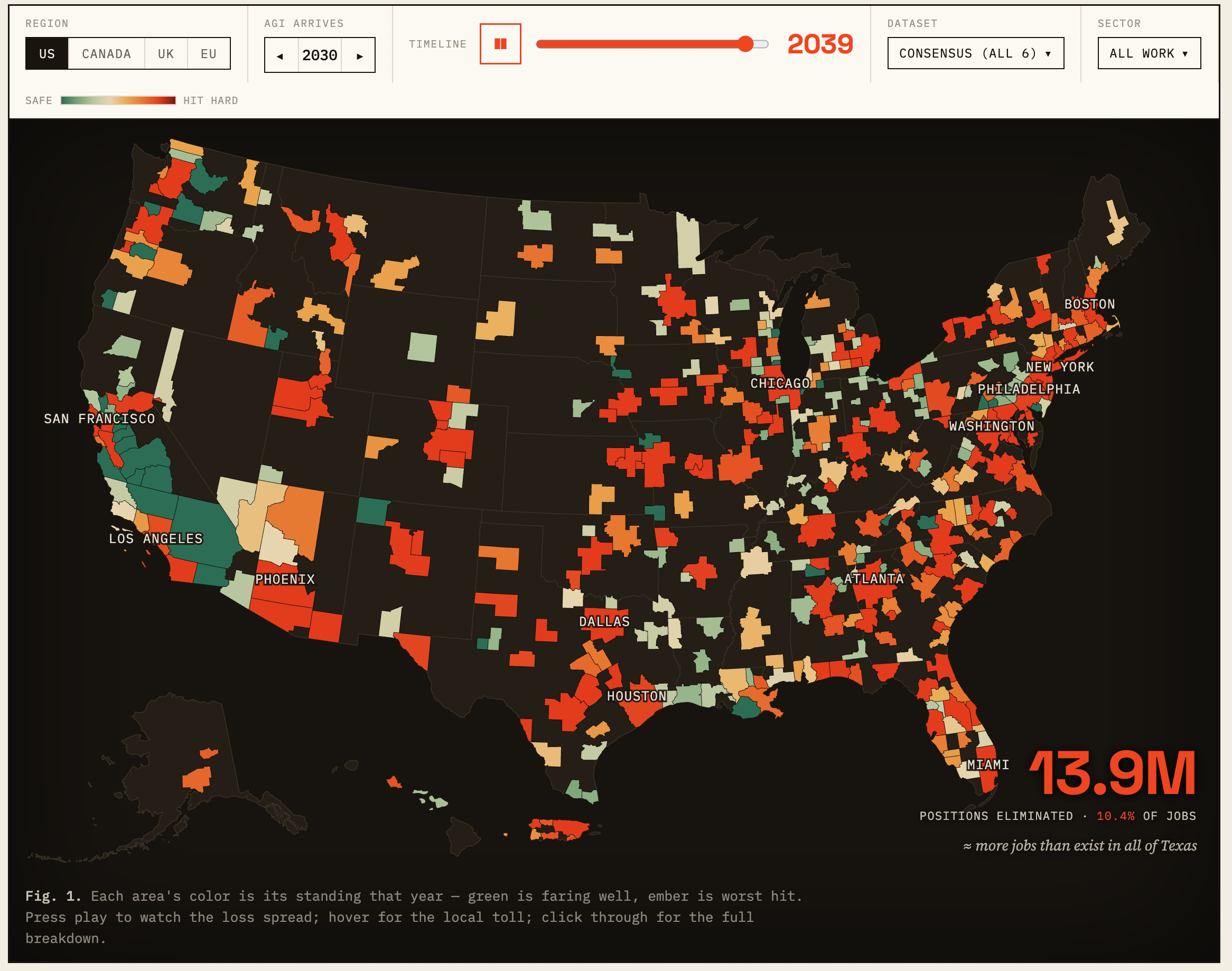
At a base level, I’ve assembled a dataset of all of the different industries in MSAs across the US, Canada, the UK, and the EU. The data is slightly different for each, and there are different data sets available for the United States versus others. Fundamentally, however, you are able to see which metro areas are most and least impacted by AI transformation.
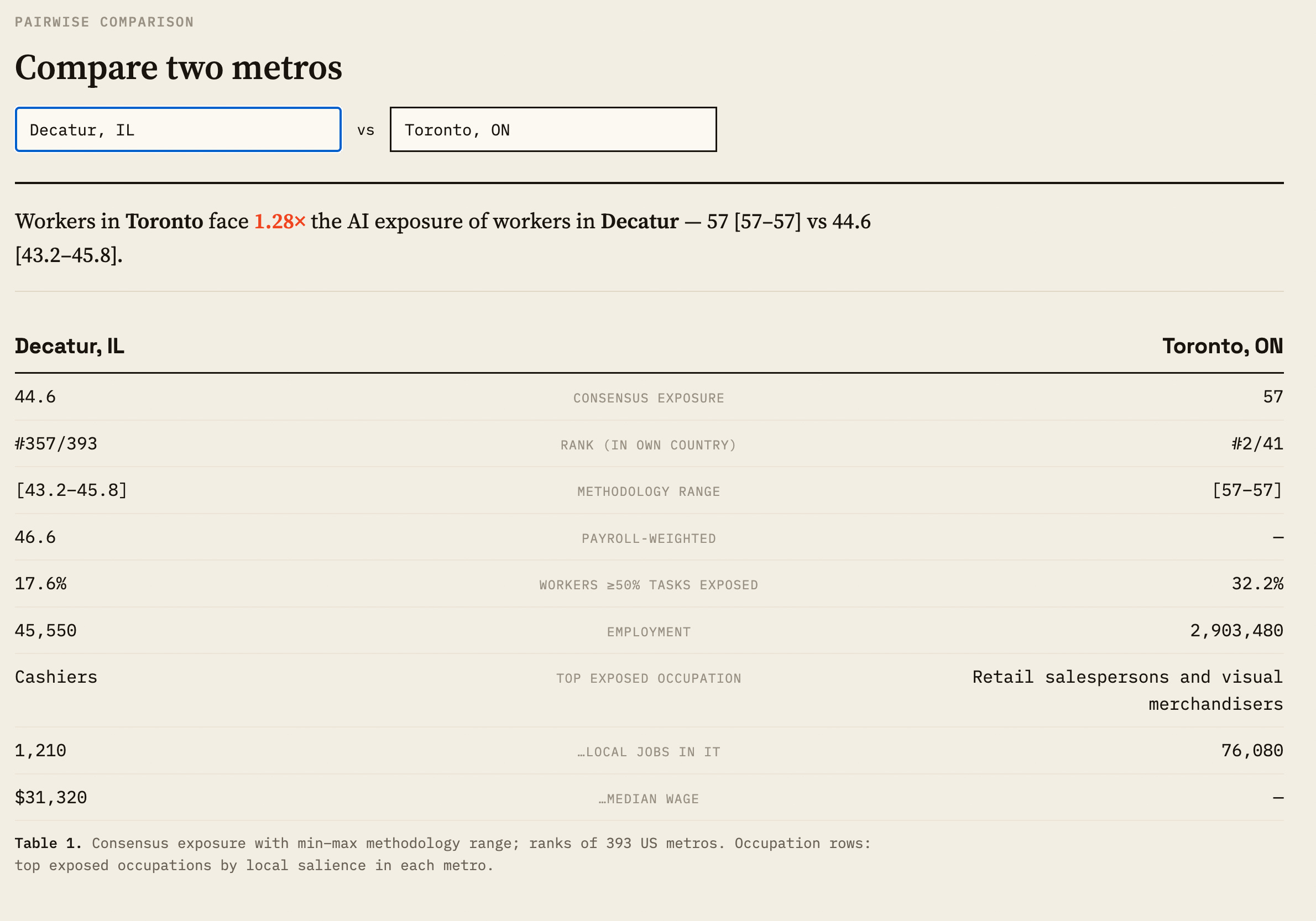
You can even compare two metrics very quickly and easily:
And finally, you can build your own scenario. Here’s mine.
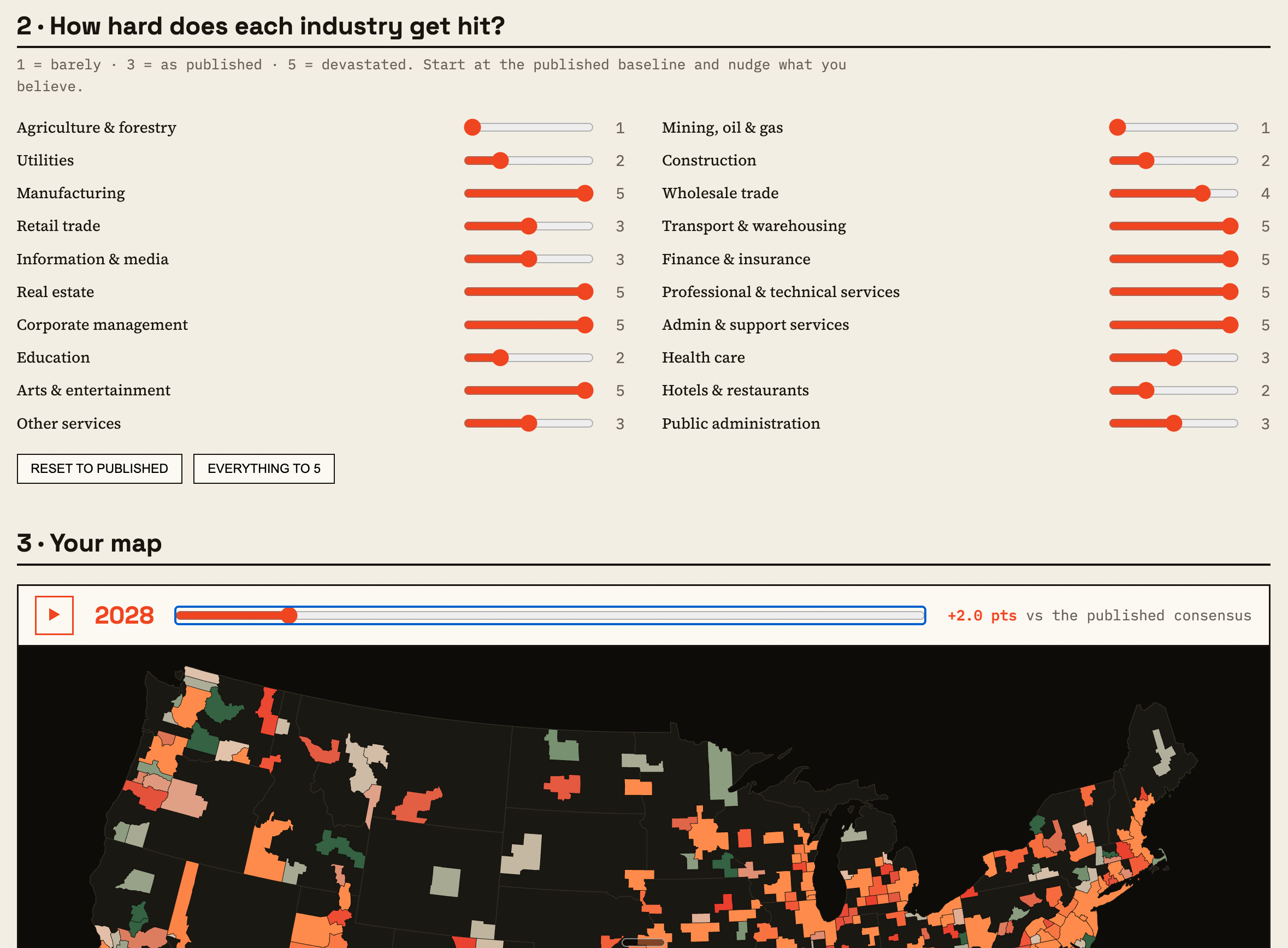
Dialing each individual industry up and down, you can see exactly where job loss will be most concentrated and where the various places that you can see this impact happening. I built this in such a way where the methodology, I think, is quite thorough; however, some assumptions needed to be made; many MSAs in the EU, the UK, and the United States do not publish sector-level data if the amounts are small. To work around this, I’ve integrated different datasets and pulled regional data on economic growth state by state. Unfortunately, a lot of the UK is missing, but I plan to expand the project if it generates interest and traction.
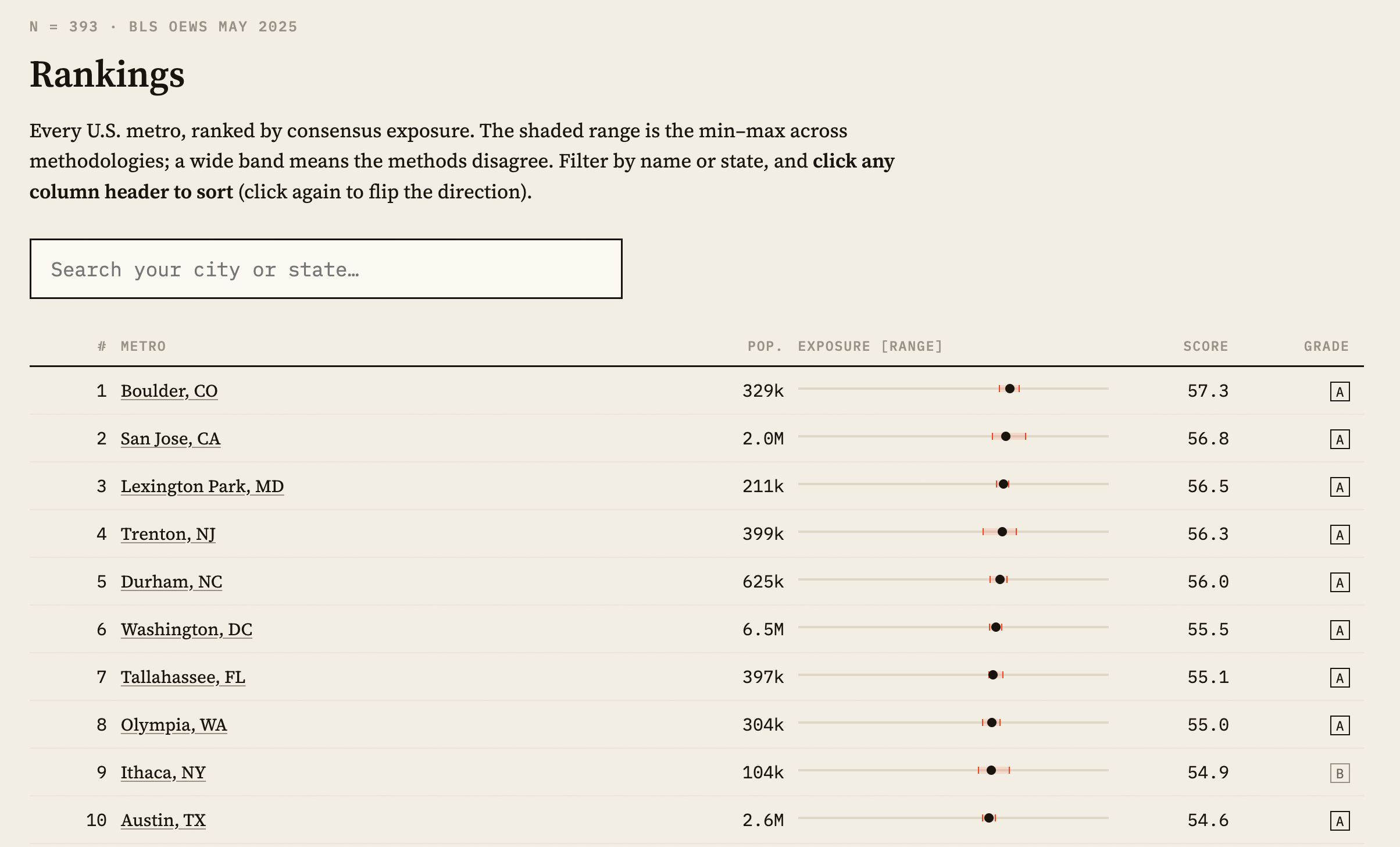
Interestingly, a lot of the places where I naturally thought they would be most exposed, it wasn’t so bad. A lot of these methodologies predate the idea that software engineering is a pretty automatable profession, so they sometimes underestimate that. I think the custom scenario builder does a better job of showing how these things can be worked out. It’s also interesting to see how many industries I would rank pretty low. That’s mostly because automation has already taken hold in them, and I imagine it will be even more intense in the future.
Predicting the impact of AI on the construction industry is not within my expertise. A fun idea would be to interview a leading authority in each of these fields and have them talk with someone who wants to build something to automate the space. I think it would spark a lot of interesting dialogue, although it might effectively just be hastening the job loss and inevitable economic catastrophe that I believe to be looming.
life choices & this data
interestingly, I believe that this has some value for people deciding where to go in America. Bay Area housing is about to enter a generational bubble, and the costs incurred for the average person to move to SF will soon be astronomical. so if the question is, “Where should I move for a post-AGI future?” the answer is probably a smaller town in California or the Pacific Northwest that does not have a big IT sector and has access to good resources, I suppose.
it’s also important to start modeling these out if you’re trying to decide where you want to start a new career, whether as a student or someone midway through their working life and about to start a new adventure.
I think it’s important to think about how these forces will affect the economy in both the near and far term.
riots in Manila
I think a better proxy for how quickly and aggressively this will come is not an American economic question, but rather a question of cities that are built on very low-skill white-collar work like Manila and Mumbai. although the cost of labor there is very low and the cost of tokens is currently very high, this will not endure. a good warning flag for AI-driven economic disruption in the United States might be the day you turn on the news and see a car burning on the streets of a city in the Philippines. That’s where about 10% of the workforce is engaged in some kind of data labeling or small-time, service-oriented white-collar work. my intuition is that these jobs are already replaceable, but momentum keeps those folks employed. That momentum will not last once the bar for building these systems starts to drop. so long as the chips flow, I believe that these jobs inevitably will be gone in 12 months.
make your own scenario
if you’re curious about this project, please take a minute to visit the site and create your own scenario. Share it with me, and in the comments, share what your 2035 job loss number is based on the assumption you’ve made.
shout out to Anthropic for making a dope model for data analysis; when your spat with Uncle Sam is up, I can’t wait to make more projects just like this.
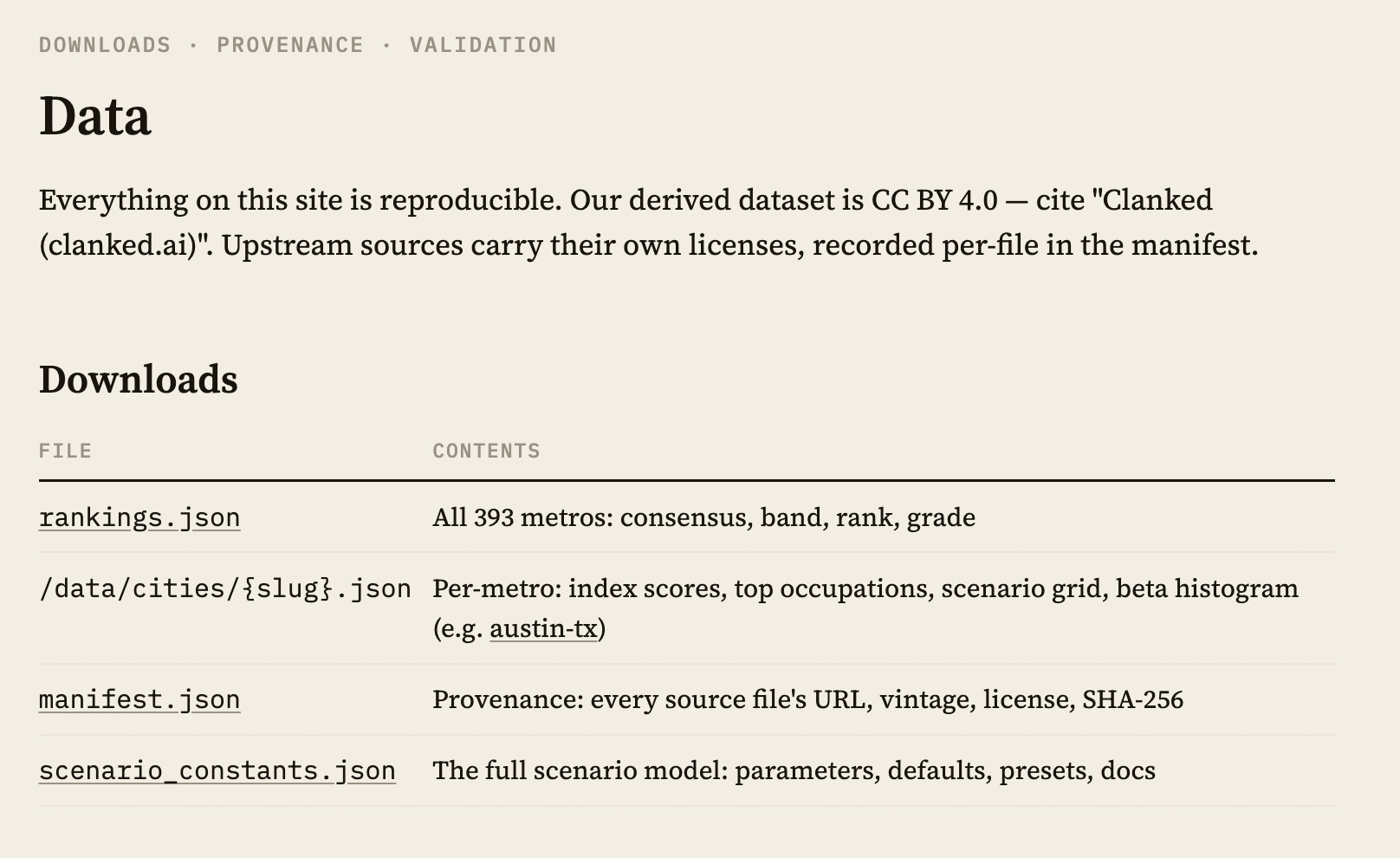
Finally, go ahead and play with the raw data yourself- downloadable for free on the site. Tell me how my methodology was wrong and I’ll debate or correct you.
Rare Bakersfield W - 11.6M