

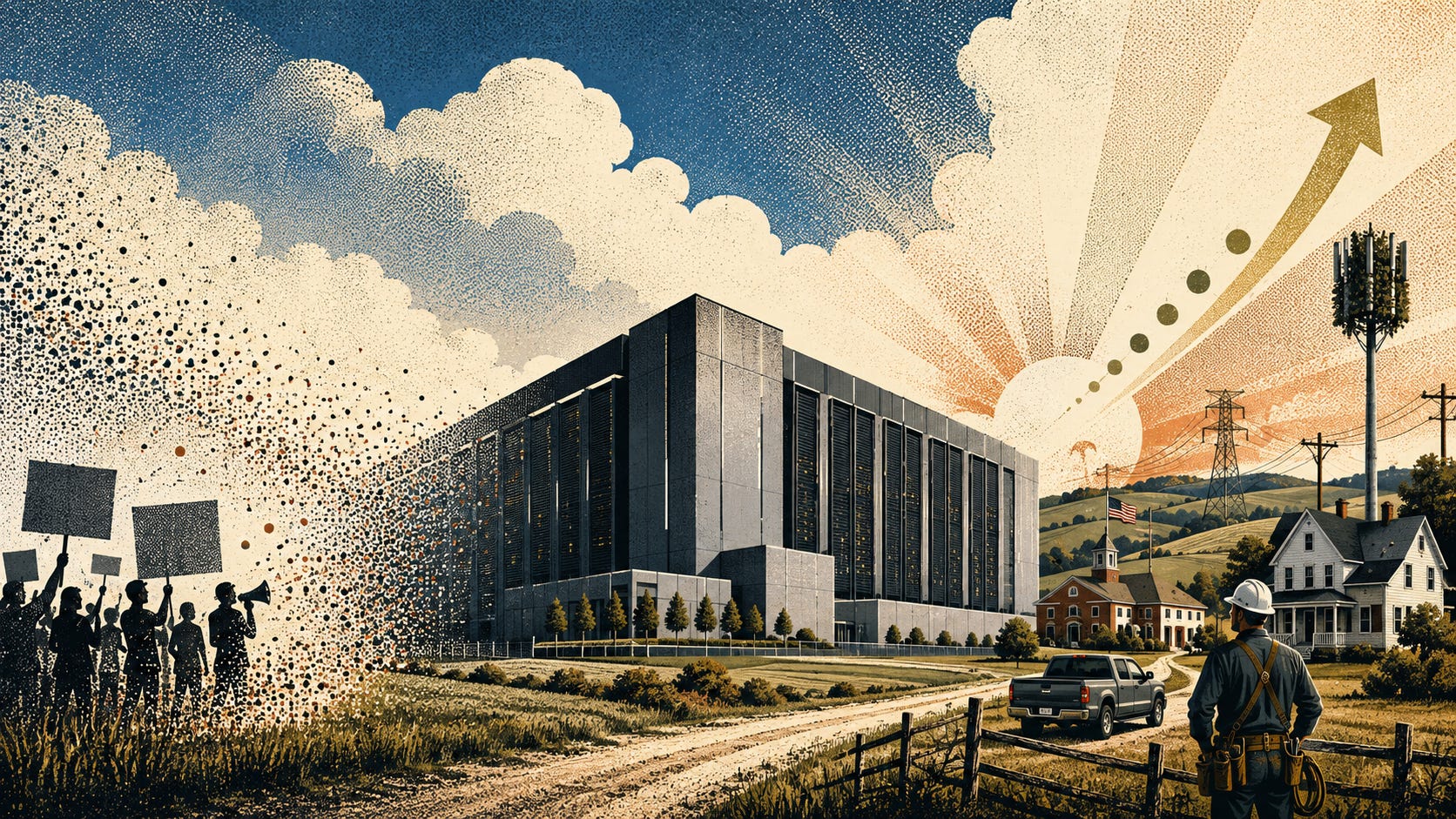
On the surface the movement against data centers in the United States has never looked more powerful. The industry lost all three local referendums this year. Moratorium bills are sitting in a dozen statehouses and general opposition in polling has gone from 43% to 75% in under a year.
I think November 2026 and its accompanying election will be the apex of this whole movement, and it won’t be a top 5 issue by November 2027. People two years from now will regard being anti-data-center with the same contempt that they reserve for people who believe cell phone and 5G towers are bad. This whole movement will devolve into a shibboleth of online leftism and libertarianism and will be relegated to the dustbin of politics.
Quincy, Washington took 56 data centers and their poverty rate fell from nearly 30% to 6.2%. Meanwhile there is no contaminant, no plume, no poisoned wells waiting to be discovered. There will never be an Erin Brockovich in this fight. A public scandal with no tort at the end is just a fight about politics- a politics that will wither away after the midterm.
Only 8% of the people who oppose data centers say that there’s one near them. 30% of supporters do. 63% of opponents hold a negative view of AI, against 8% of supporters. Pew geolocated the whole country and found that 42% of us live within 5 miles of a data center, operating or planned. Living near one barely moves your opinion in either direction. The people angriest about data centers are, overwhelmingly, people who have never lived near one.
This is just anger about AI and political strife. This issue will die once there are no politicians to pressure ahead of an election.
The cell phone towers that we used to hate ended up dressed up as pine trees in rural areas. Data centers have been built in the middle of downtown Manhattan, dressed as ordinary office buildings, and nobody complains. Industry will get better at putting floats in fall fairs, paying for schools and hospitals and rec centers, and integrating architectural improvements that make it feel harmonious with communities.
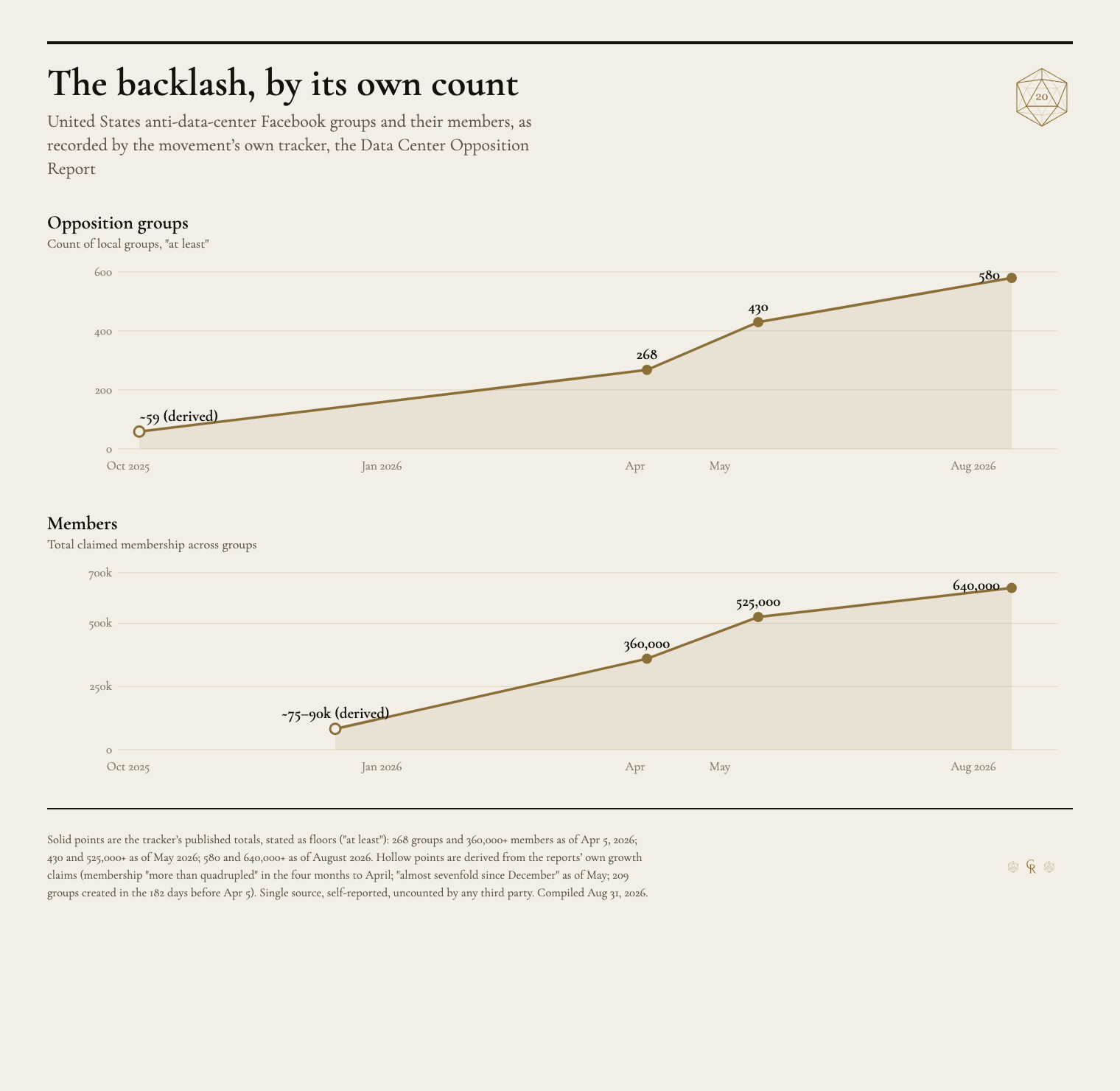
The movement against data centers on Facebook is already showing this slowdown. The 580 local opposition groups holding 640,000 Facebook memberships are not increasing at the same rate that they used to. I think this probably represents less than 400,000 people total and 18% of this entire national total sits inside a single group in Missouri.
These will not last. There are bigger and better ways to hate AI than something that brings wealth and success to rural communities that have been disenfranchised and ignored for 25 years.
playing with real money
Augusta Township in Michigan voted rezoning down at 89%: 2,583 votes. All told, the movement counts $130 billion of projects as blocked or delayed. There’s just no way that with all of this happening we cannot find a way forward; inference is simply too good a business.
I was really impressed by a recent Dwarkesh podcast featuring Dylan from SemiAnalysis and their discussion around just how valuable data centers are. We will inevitably find a way to fix this.
kooky cell phone tower ‘revolt’
In the 90s America convinced itself that cell towers were a public health emergency. Zoning calendars filled up with testimony about tumors and the fights were sincere across the country; people genuinely believed that these towers were making them sick.
Today those panics are barely remembered at all: a conspiracy theory from the fax machine era. Congress, in the 1996 Telecom Act, barred local governments from blocking towers over radio frequency health fears as long as the equipment met federal limits.
The reason why people stopped complaining about cell phone towers is because phones became indispensable. It took us a little while to get there. We didn’t have a great mobile phone even at the end of the 90s, but we got there. You could not pull smartphones out of America today if you tried, and the same exact thing will happen with AI.
A gigawatt campus is a bigger neighbour than a monopole; harder to shoehorn into a rural community. That’s what the money is for. The only difference between these two groups, pragmatically speaking, is that telecom has always been good about telling a story of the importance of their build-out, even as they genuinely ignored rural communities. How long have you been having a fight about rural broadband in the United States? The building trades told The Wall Street Journal that they will oppose candidates who attack data centers and the IBEW alone is 900,000 members.
a factory with no smokestack
We’ve spent forty years begging heavy industry to come home to America. Facility against facility, the largest hyperscale campus in the country emits roughly one hundredth of the smog-forming NOx of one Indiana steel mill and around one-thousandth of the fine particulates, two to three orders of magnitude cleaner, building for building. If you add up the entire national data center fleet in the EPA’s inventory, one single mill still out-emits all of it, 5.9 times over on NOx and 47 times over on fine particulates. One cement plant in Alpena, Michigan, beats the whole fleet on NOx by itself.
No facility classified as a data center has ever emitted enough on-site to trigger EPA’s greenhouse gas reporting floor. A data center supports far fewer permanent jobs per megawatt than conventional industrial projects but it also produces demonstrably less of the negative externalities that poison rural communities. Loudoun County’s own accounting says a dollar of services provided to data centers returns 26 dollars of tax revenue, against a manufacturing norm that rarely beats four. On the jobs math a data center is much like a chip fab and no one’s calling TSMC Arizona a jobs failure.
There is no hexavalent chromium coming out of data centers; the best opponents have come up with is a hum. There are active suits alleging noise and nuisance, and even water claims. It’s my bet that they will fail, all of them, because there is nothing in the construction of a data center that inherently needs to be noisy.
We can solve these problems and in fact we already have. In Bartow County, Georgia, the county put closed-loop cooling and forced decibel limits into its ordinance before the first slab for their data center was poured.
This is a fight about money. Rural communities need to get paid and they need to be participants, even in some small way, in AI. If these communities accepted oil wells on their properties, they’ll accept data centers in their outskirts. A few years from now, using AI to solve problems will be regarded with the same kind of pride one feels filling up a car in Texas. “This is something that we make here.”
show me the money
It’s a little early for great data but early causal work says counties that receive their first large data center see total employment rise 4-5%, with incomes and home values coming up as well. Texas data center electricians under 30, debt-free, clearing north of a quarter million a year, have become a standard story in this industry. Journeymen can make $40 an hour, working double overtime weeks with remote site premiums and untaxed per diem stacked on top. Wyoming has seen union managers talking about crews that cleared $190k. Texas data center builds pay about double what home builders pay. Apprenticeship applications are up 70% nationally and whole union locals have doubled.
In Richland Parish, Louisiana, school teachers opened up end-of-year checks up to $50,000 this summer, more than the parish median teacher’s salary, paid out of Meta’s construction taxes. Ellendale, North Dakota, with under 1,200 people, watched sales tax receipts go from $400K to $3.5 million in seven months.
The data is again early, but Americans without college degrees and non-white Americans already poll friendlier to data centers than the median. The single most opposed group is college-educated white women.
It’s my firm bet that this becomes a leftist-online shibboleth, not a national revolution, in under two years.
This money will start hitting rural communities soon. Those people making a quarter million dollars a year will start marrying into families, buying new cars and trucks and having the best house on the block. Those types of things get noticed in smaller communities faster than in cities, and eventually data centers, for all their inglorious squat presence, will be correctly cited as the reason that those folks got rich.
aligned interests
Today Virginia’s own report shows the state booking $1.72 billion in tax revenue from this industry over five years. Virginia is by far the most dense data center state in the Union as of today, and its localities are projected to collect about $3.6 billion.
As this technology matures and it becomes more instrumental in our economy, how big could that number get? A 1 GW AI campus generates somewhere between $12 and $50 billion a year in compute revenue, depending on chips, workloads, and pricing, if I understand the math right.
I don’t think it’s inconceivable that the community share could be 5% of net flows; inference is wildly profitable and we have to get these things built. It’s my belief that this entire movement is really, at its core, about the political pressure required to get to that 5%. The cost of that 5% can be shared across the stack but that scenario still hands a host county hundreds of millions a year, and in a place like Pennsylvania, it would be more than six times what the entire statewide fracking impact fee would raise.
There is no possible way that data centers will end up less popular than fracking in a state like Pennsylvania, if five times, six times more money gets poured into the state.
Our problem is that the political willpower to ask for that big a cut does not seem to exist so far. We’ve seen one congressional candidate’s draft proposal for half a percent of gross, but that share should be structured like insurance, a uniform statutory percentage. Casinos taught us that bespoke carve-outs die in court so we should start paying these communities like Alaska gets paid for oil.
Casinos are in many ways a great representation of the ways that these communities are going to think about AI in their backyard. A small number of people get obscenely rich, a larger number might get hopelessly lost in it, but most folks will benefit from the tax revenues, even if they find it distasteful to have in their community.
Sixty-three percent of the anti-data-center movement hold a negative view of AI itself, and about three quarters of them say the system is rigged. This aligns well with how I think about casinos- the system is rigged, and you’re a sucker for playing.
A Michigan candidate explaining why data centers are the loudest issue in his district said it brings together Trump voters, anti-vaxxers and environmentalists “because none of us trust big tech to do right by our communities.” The industry keeps arming that distrust from the top. Dario Amodei’s prophecies of the coming jobpocalypse aren’t making any friends in communities with blue collar industries either; I grew up in a rural blue collar community and most families dreamed of their kids working a desk job one day.
Growing up in towns like these I know another simple truth- rural people don’t like AI, but they hate lawyers. Rolling in with a legal department and blanket NDAs was the stupidest move of any data center build-out plan.
In Independence, Missouri, every councilmember who voted on a 90 percent tax abatement for a hyperscaler had signed one; residents sent 43 questions to the mayor, the mayor sent them to the company’s lawyers, and most never came back. The biggest anti-data-center group on Facebook, 117,000 members, was born in the weeks after that meeting. Data center companies and hyperscalers are in the business of building community trust, and they’re starting from far, far behind.
This time next year we’ll have some type of ceasefire here; a fair process and better terms for rural communities, built on the hard and bitter lessons of this next election.
The playbook is already forming- tariffs will price grid costs in, just as revenue shares will price the towns in. Siting these facilities well and keeping tree coverage high and sightlines low will go a long way, and the money will do the rest. We’ll see Meta’s billion-dollar community funds as a joke compared to the scale of the data center build-out and the accompanying capital flows into rural communities; we’ll see community investment frameworks putting labor at the table and the siting machine moving to state-owned mega sites on federal land, where the nearest neighbor is a military base, not a suburb.
My guess is that what remains of this opposition settles into a left-coded cause with libertarian company, just like those cell tower opponents. By Christmas next year this will be somewhere in the fifth-to-tenth tier of political issues when people are polled. By 2030 data centers will be energy, water, and cash positive for communities. Within two years a county will find a way to sign the first real revenue-sharing deal with these companies and every single county admin across America will copy their homework. America will be a better nation for it.
sources & notes (AI generated)
Quincy, Washington — CNN (Aug 11, 2026): 56 data centers; poverty 29.4% (2012) to 6.2% (2024). https://edition.cnn.com/2026/08/11/business/data-centers-ai-economy
Referendum record — Augusta Township MI 89.5% (MLive, Aug 2026), https://www.mlive.com/news/ann-arbor/2026/08/voters-in-augusta-township-reject-rezoning-farmland-eyed-by-data-center-project.html · Port Washington WI 66% (Apr 2026) · Monterey Park CA 88.33%, LA County Registrar (Mar 2026).
Polling trend — Embold Research via Heatmap: 43% support/42% oppose (Sept 2025) to 75% oppose (Aug 2026). https://heatmap.news/daily/data-center-opposition-poll-collapse
Proximity and AI-sentiment gaps — Milltown Partners, “Behind the Backlash” (June 2026, n=6,872; a communications consultancy advising technology clients; opponent/supporter subgroups run on smaller samples): 8% of opponents vs 30% of supporters report a nearby data center; 63% vs 8% negative on AI. https://cdn.prod.website-files.com/67d182bd6016f997fd72999a/6a38f1fa6f06adc2ada33899_Milltown%20Partners_Behind%20the%20Backlash_June%202026.pdf
42% within five miles; proximity null — Pew Research Center (Apr 13, 2026, n=8,512). https://www.pewresearch.org/short-reads/2026/04/13/most-new-data-centers-in-the-us-are-coming-to-rural-areas/
Opposition group counts — Data Center Opposition Report (the movement’s own tracker; self-reported floors): 580 groups, 640,000+ memberships (Aug 2026); series and derivations in the companion graph. https://datacenteropposition.com/wp-content/uploads/2026/08/August-2026-DCOR1.pdf
Blocked-projects tracker caveats — Data Center Watch ($130B Q1 2026 claim; run by 10a Labs, undisclosed funders; no causal claim per its own methodology; ~$14.5B of the original $18B “blocked” was two relocated or returned projects). https://www.datacenterwatch.org/report · methodology check: https://www.datacenterdynamics.com/en/news/group-claims-64bn-in-us-data-center-projects-impacted-by-local-opposition-in-last-two-years/
Dwarkesh and Dylan on data center economics — Dwarkesh Podcast, Dylan Patel (Aug 25, 2026).

Section 704 — 47 U.S.C. 332(c)(7)(B)(iv), Telecommunications Act of 1996: bars state and local regulation of tower siting on the basis of RF environmental effects for compliant facilities. https://www.law.cornell.edu/uscode/text/47/332
Trades’ electoral warning — WSJ via A. Ramkumar (Aug 28, 2026); Newsweek, “Anti-Data Center Movement Is on Collision Course With Labor Unions” (Jul 27, 2026). https://www.newsweek.com/anti-data-center-movement-on-collision-course-with-labor-unions-12243081 · IBEW anti-ban toolkit: https://ibewgov.org/no-to-data-center-bans-yes-to-labor-standards-toolkit/
Emissions comparisons — EPA 2023 National Emissions Inventory facility summary (released Jul 2026): all 280 data-center point sources combined 1,334 t NOx and 68 t PM2.5; Cleveland-Cliffs Burns Harbor 7,857 t NOx and 3,199 t PM2.5; Holcim Alpena 3,752 t NOx; largest hyperscale point source (Amazon, Prince William VA) 77.6 t NOx, 2.8 t PM2.5. NEI depends on state reporting and undercounts; the fleet total is a floor. Per-facility comparison is the two-to-three-orders claim; fleet-level is 5.9x/47x.
GHG reporting floor — EPA GHGRP (25,000 mtCO2e/yr onsite): no facility classified under data center NAICS codes has reported except flare-gas sites. https://www.epa.gov/ghgreporting/what-ghgrp
Jobs per megawatt (the disfavoring denominator) — AEP Ohio: 25+ jobs per MW for traditional industrial customers, under 1 for data centers.
Loudoun fiscal ratio — Loudoun County FAQ: $1 of services returns $26 of revenue; data center property assessed ~$609/sq ft, ~3x other commercial. https://www.loudoun.gov/faq.aspx?TID=241 · The 4:1 manufacturing comparator is NVTC’s (industry association): https://www.nvtc.org/communities/data-center-and-cloud/report/
Chip fab comparison — TSMC Arizona ~$10.6M to $11.5M capex per permanent job vs data centers’ $13M to $54M vs auto ~$0.9M; assembled from CSIS analyses and site-selection reporting.
Noise litigation and ordinances — WilmerHale litigation overview (Jul 13, 2026), https://www.wilmerhale.com/en/insights/client-alerts/20260713-data-centers-in-court-the-emerging-wave-of-nuisance-environmental-and-land-use-litigation · Bartow County GA policy statement and zoning ordinance (Aug 2026), https://cms2.revize.com/revize/bartowcounty/CommissionerOffice/PUBLIC%20RELATIONS_DATA%20CENTERS_BARTOW%20COUNTY%20POLICY%20STATEMENT_8-2026.pdf · Prince William County C-weighted Ordinance 25-62 via Virginia Mercury (Aug 25, 2026), https://virginiamercury.com/2026/08/25/the-thousand-dollar-line/ · JLARC Report 598 (noise findings, 40-59 dB), https://jlarc.virginia.gov/pdfs/reports/Rpt598.pdf
Causal employment effects — Bahar & Wright, Brookings (May/Aug 2026): total private employment +4-5% over five to six years in counties receiving a first large facility; home prices +2-5%. https://www.brookings.edu/articles/new-evidence-on-data-center-employment-effects/
Income effects — Alvarez, Argente, Chow & Van Patten, NBER Working Paper 35194 (May 2026): adjusted gross income +8.2% in data center counties at the 2020 horizon (the employment effect loses significance with state fixed effects; the income result is the relevant one here). https://www.nber.org/papers/w35194 · Yue & Zeng, Georgia Tech (Mar 2026): median household income +1.9%, gains concentrated in metro counties. https://papers.ssrn.com/sol3/papers.cfm?abstract_id=6497238
Electrician pay — Mike Rowe accounts via Fortune (Mar 19, 2026) and NY Post (May 6, 2026); pay-stack arithmetic: https://goherebro.com/blog/texas-data-center-electrician-jobs-tdlr-license-2026 · Local 415’s $190K crew: Cowboy State Daily (Apr 5, 2026), https://cowboystatedaily.com/2026/04/05/us-data-centers-drive-explosion-in-pay-for-electricians-some-as-much-as-260-000/ · double homebuilder pay: Texas Tribune via Governing (Apr 28, 2026), https://www.governing.com/workforce/data-centers-strain-electrician-workforce-in-texas · Local 26 journeyman ~$120K and apprenticeships +70%: Fortune (Mar 2, 2026), https://fortune.com/2026/03/02/ai-data-centers-electrician-shortage-gen-z-training-careers/
Richland Parish teacher checks — The Advocate via GovTech (Jun 15, 2026): certified-staff shares up to $50,935 vs parish median teacher salary $40,920; construction-period sales tax. https://www.govtech.com/education/k-12/data-center-tax-revenues-yield-50k-bonuses-for-louisiana-teachers
Ellendale — SF Chronicle (Aug 8, 2026): sales tax ~$400K/yr to $3.5M in seven months; taxable property $3.5M to ~$35M; rents doubled; Aberdeen SD moratorium. https://www.sfchronicle.com/opinion/article/data-centers-artificial-intelligence-dakotas-22362642.php
Demographic crosstabs — the non-college and non-white-respondents-friendlier-than-median finding is Embold Research’s May 2026 crosstabs (n=4,118 registered voters) via Heatmap, https://heatmap.news/politics/americans-oppose-data-centers-poll · the most-opposed-group figure (college-educated white women, 84%) is Fox News’s July 17-20, 2026 poll (n=1,003 registered voters, Beacon Research/Shaw & Company), https://www.foxnews.com/politics/fox-news-poll-cool-your-servers-voters-reject-data-centers
Fracking disamenities priced — Bartik, Currie, Greenstone & Knittel, AEJ: Applied (2019): local costs ~$1,000-1,600/household/yr.
Virginia tax split — Virginia RD40 (Jan 2026): ~$1.72B estimated five-year state tax revenue; ~$3.63B modeled five-year local revenue; operator data self-reported. https://rga.lis.virginia.gov/Published/2026/RD40/PDF
Revenue per gigawatt — SemiAnalysis (Aug 7, 2026): scenarios from ~$12-13B to $30-50B (compute rental) to $100B+ (API inference) per GW-year; the 5%-of-net-flows arithmetic uses the full range.

Pennsylvania Act 13 comparison — PA PUC 2025 distribution: $243.8M statewide; $3.12B cumulative since 2012. http://paenvironmentdaily.blogspot.com/2026/06/puc-announces-distribution-of-2438.html
The 0.5% proposal — a congressional candidate’s draft (Floyd Michael Taylor), described by Brookings; not an introduced bill. https://www.brookings.edu/articles/why-community-benefit-agreements-are-necessary-for-data-centers/ · https://floyd2026.com/docs/datacentersbill.pdf
Casino local-share precedent — PA Supreme Court struck the non-uniform host fee (Sept 2016). https://www.mcall.com/2016/09/29/state-supreme-court-strikes-down-casino-host-fee/
Internalization wave — 38 large-load tariffs 2018-2026, 30 in 2025-26 (E3 count; E3’s rate study was commissioned by the Data Center Coalition); PJM’s Aug 2026 FERC filing excluding unbacked large loads from the 2029/30 capacity requirement. https://insidelines.pjm.com/pjm-proposes-framework-to-connect-data-centers-without-compromising-reliability-affordability/
Meta community fund — $1B, Aug 2026. https://www.businessinsider.com/meta-ai-data-center-one-billion-dollar-fund-backlash-2026-8
State-owned megasites and federal land — Meta’s Louisiana generation sits on Franklin Farms, a 2,250-acre state-owned tract (Louisiana Illuminator, Aug 20, 2025), https://lailluminator.com/2025/08/20/entergy-meta/ · federal-land siting per EO 14318, Accelerating Federal Permitting of Data Center Infrastructure (Jul 23, 2025), 90 FR 35385.
New York EO 62 — statewide moratorium paired with a Community Investment Framework (labor at the table, PLAs, community fund) and large-load interconnection reform. https://www.governor.ny.gov/executive-order/no-62-establishing-temporary-moratorium-data-centers-new-york-while-state-develops
Fair process beats cash — Mills, Bessette & Smith, Land Use Policy 82 (2019): post-construction attitudes bifurcate on procedural fairness; money moves attitudes “only in the short-term.”
Nuclear and generation stack (energy-positive basis) — Talen-AWS 1,920 MW; Meta-Constellation 1,092 MW; Google-Kairos 500 MW; Amazon-X-energy 320 MW; Meta 6.6 GW nuclear RFP; Entergy 1,500 MW solar commitment; Google 1 GW demand response. Assembled from company releases and regulatory filings.
Modern civilization now rests on four primary pillars:
1. Water for drinking and agriculture.
2. Energy for homes and industry.
3. Sewage systems for waste treatment.
4. Compute capacity for information processing.
Data centers compete with society for two of these pillars namely water and power. They require enormous amounts of both, and their demands are growing rapidly as the AI arms race accelerates. This pressure comes at a time when many regions are already economically strained. In some places, utility costs are rising while post-COVID economic aftereffects have weakened local tax bases. The result is a growing tension between digital infrastructure and public well-being.
I think data centers will continue to be the focus of increasing public resentment, growing protest and potentially violence. You can already see the pattern emerging. Across municipalities, people are agitated about water and power being diverted toward these facilities. They ask a fair question: Why should the needs of data centers outweigh the needs of local communities?
It’s easy to see how the modern data center has become a kind of universal symbol of broader public anger and resentment. Both data centers and AI have come to be seen as a mysterious monster that sucks up water and power like an invisible digital Godzilla. When people feel ignored and pushed aside, when the essentials of life are rationed or made more expensive, people look for something to blame. A massive structure, owned by distant billionaires and filled with silent machines drinking power and water 24/7, makes for an easy villain.
Strongly agree.