

the two-hundred-and-fifty-year dread
Happy fourth, everybody. Social media will tell you that empires last precisely 250 years before they punch out and fall into ruination. This is a lie of course, but even more of a lie than most tidy internet facts; the man who made this up (who has the ignoble name of Glubb, his pamphlet was the Fate Of Empires) got this idea into popular imagination. I imagine pamphlets were the shitposts of the 1970’s, so he’s forgiven his sin of counting the fall of the Roman empire at the death of Marcus Aurelius, not 300 or 1300 years later.
Comparing empires is silly unless you account for their size; keeping giant nations like America together is hard work, while I (possibly ignorantly) imagine this to be an easier process in, say, Holland.
So instead of counting the years that a given empire exists, I propose a new framework:
Subject Lifetime Years (SLY)- the number of lived years of the subjects of your empire.
This is a superior unit of empire success measurement for two reasons:
Citizens are currency of empire, and so their lives should be the unit of measurement.
It values large empires, empires with great life expectancy, and disincentivizes wars.
A small country, enduring for millennia, could theoretically have a higher SLY score than a giant flash-in-the-pan. Likewise, plagues, wars and emigrations make your SLY score go down.
So how do the empires of history stack up? (roughly, this is a fun project not a sociology thesis)
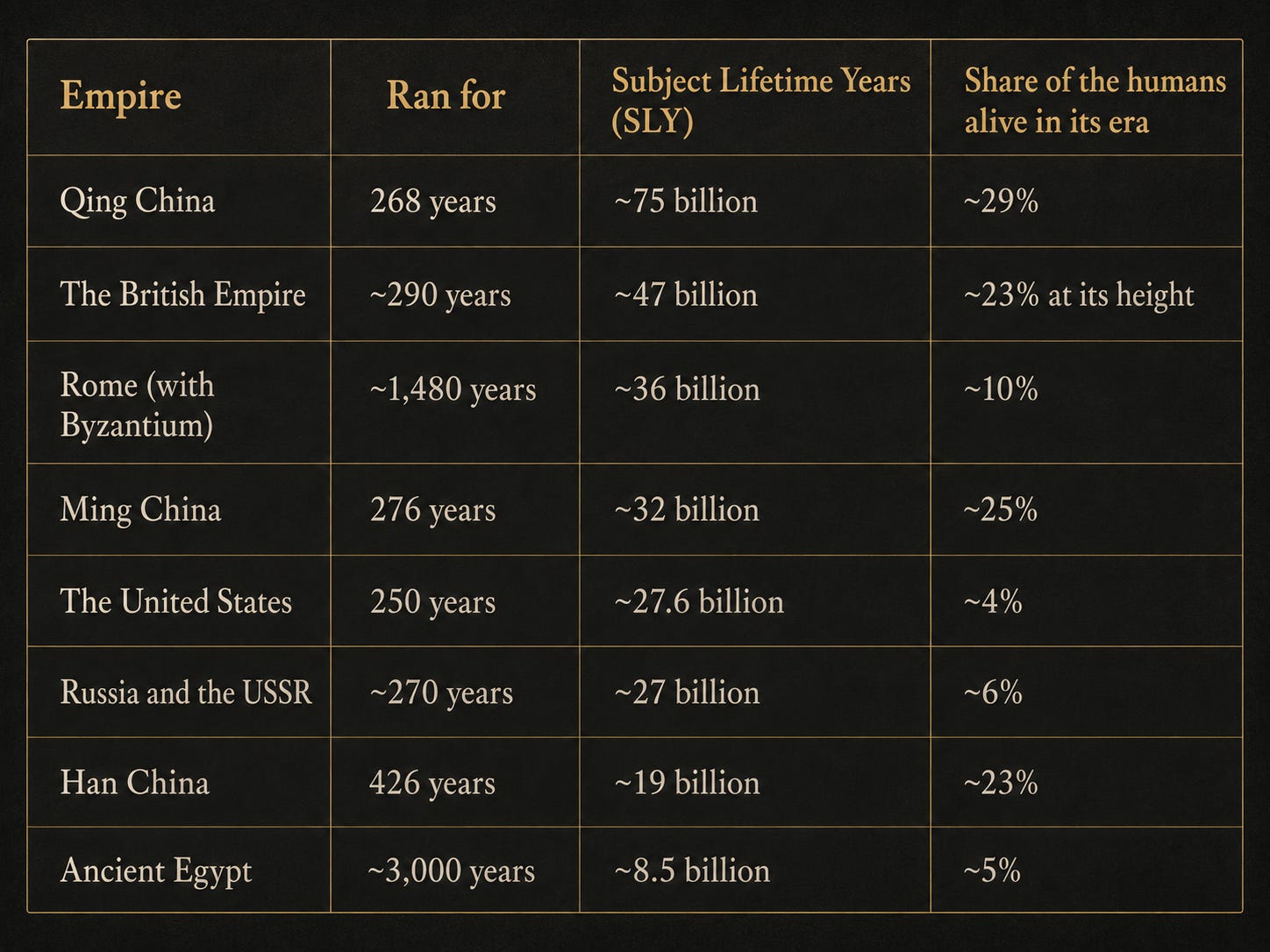
America at 250 has already carried more human life than the Han, as a modern nation of 300 million out-guns the ancient 60 million even if it lived twice as long. Nine-tenths of every American SLY happened after 1900!
Interesting also that Egypt, which endured for three thousand years (12 times the length of America’s run so far) is sitting very low indeed due to the tiny population relative to today.
The British Empire, in second place, is barely a story about Britain at all, since seven in ten of those subject-years were Indians ruled by a crown most of them never saw, which makes the number a monument to how many people you can rule without their say-so. Only Rome earns its place (justly) as both a massive population and an enduring empire, but not a lot of those folks were lounging on sofas eating grapes.
Finally I am amazed at just how small the % of total global population America is every time I see the number. America is so BIG; such a massive undertaking, so brassy that you cannot imagine that this glorious empire has the smallest percentage share of the world’s population on the list.
celebrating 27.6 billion American SLY
Of the 27.6 billion American Subject Years:
24 billion were lived by someone who had seen an airplane in flight
2.6 billion were lived by immigrants
2.3 billion were lived in California (1/4 of ancient Egypt!)
1.2 billion of them were lived in the age of AI (since Nov 2022)
160 million were lived in slavery (not including sharecropping and other forms of bondage)
2.9 million were lived past the age of 100
America, you’re one of the six or so largest gatherings of human life any government has ever presided over, and you’re only getting started. Happy birthday, Uncle Sam.
sources (AI generated)
Glubb, The Fate of Empires (1976), full text — cherry-picked endpoints visible in his own table; serious version is Turchin & Nefedov, Secular Cycles (2009). Subject-year figures = ∫ population dt over sourced anchors (worksheet and ranges in my notes): Han 2 CE census 57.7M; Qing peak ~436M c.1850; Rome peak ~65M c.165 CE (Scheidel); British peak ~412M / ~23% of humanity, 1913; US = Census Bureau; pre-modern anchors from McEvedy & Jones (1978) + Maddison. “Share of era” = subject-years ÷ world subject-years, rough. Caveat: the British total depends on counting colonial subjects as members.
the brassiness of America is such that I always forget so many of the opinions online I deeply engage with are, in fact, American opinions, until each July 4th! Enjoyed this, thank you. And...
pamphlets were the shitposts of the 1320's to the 1970’s, no?