There has never been a more triumphant week in open-source AI than the one that we just experienced. We’ve fulfilled some of the promises of the ATOM project, built a coalition through hard work that will push back on the possibility of heavy regulation, and got almost everybody in the ecosystem on board with a vision for intelligence that is more open and free.
I think we bought ourselves six to twelve months, tops, so long as nothing goes wrong.
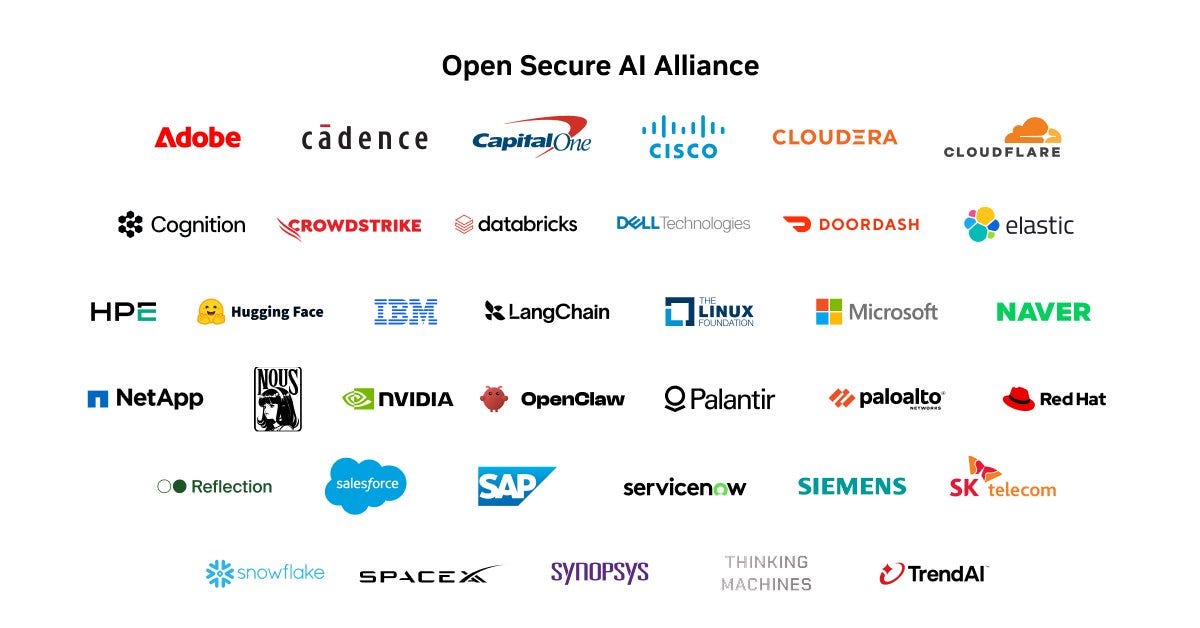
If you or a company that you work for signed the open weights letter this week, thank you. Open models need your help. If we want to realize the promise of that letter, a whole lot of people that just put ink to paper have to roll up their sleeves and get involved. The signatory list now includes a long tail of companies and investors who do not usually stand in the same line. And now NVIDIA has put a much sharper operational version of the argument on the table with the Open Secure AI Alliance: attackers have frontier AI, so defenders need a frontier AI ecosystem too.
So you like open models? What are you going to do about it?
Adulthood
The awkward teenage years of open-source AI are over as of today. We have undergone a collective ritual of manhood, overseen by our leather-jacket-clad patriarch, and from here on in we’re going to retire a whole bunch of things we’ve been saying for years:
Open models are good
Open models are necessary for American competitiveness
Banning open models would be stupid
From now on, all of these things are table stakes. They are implied in every conversation, and we do not need to spend six months talking about them on Twitter.
Open Model Adulthood comes with responsibilities:
Licenses
Release processes
Shared tooling
Data provenance
Safety ledgers
Funding models
A whole lot of pan-Pacific diplomacy
Linux did not become infrastructure because people loved freedom in the abstract. It won with kick-ass licenses, foundations, package systems, dedicated maintainers, serious security, enterprise support, conferences, norms, and a large amount of deeply unsexy plumbing.
Our little movement has grown up and is now paying a mortgage, driving on bald tires, and trying to get a kid into Harvard. Roll up those sleeves.
TLDR List to Send to Your Boss of How to Get Involved
Decide what kind of open you support.
Keep serious labs releasing.
Build shared plumbing.
Share training artifacts and process knowledge.
Fund documentation and research engineering.
Build data commons people can inspect.
Make models for places with bad margins.
Build safety ledgers, evals, and open defense stacks that can cross borders.
Engage Chinese labs on safety.
Reassure Washington and Beijing with different evidence.
Solve IP disputes narrowly.
Pay for the boring institutions.
This is open source- you don’t need to ask anyone’s permission to just do things.
Casual readers can stop now. Open model nerds and people who are genuinely interested in finding their place in this ecosystem, please keep reading. I’ll break down these points one by one.
1. Decide what kind of open you support
An open model means about eighteen things as of today; sometimes it means downloadable weights, sometimes a model that is free for research or free for commercial use under restrictions, etc.
Back when we were all enthusiastic nerds, this was totally fine. Now we have lawyers, procurement officers, national security staff, and normal everyday American businesses in the room with us, so somebody, possibly you, needs to sit down and make some definitions happen.
The Open Source AI Definition is useful because it is stricter than the way a lot of AI people talk. It says an Open Source AI system has to grant freedoms to use, study, modify, and share. It also says the preferred form for modification includes data information, code, and parameters. In other words, weights alone do not magically become “open source” because the download button exists.
The good people of PyTorch and the Linux Foundation are already working on this. Matt White helped build OpenMDW, a model, data, and weights license meant for AI artifacts rather than retrofitted software code. The Hugging Face explainer makes the basic case, and the PyTorch Foundation’s licensing post explains why model licensing is different from ordinary open-source software licensing. More recently, the Linux Foundation released OpenMDW-1.1, with NVIDIA adopting it across future releases of Cosmos, Isaac GR00T, Ising, and Nemotron.
Cost of inaction: DC will decide what this means for us.
Follow: Matt White, because OpenMDW is the clearest current attempt to give model releases a purpose-built permissive license.
People who should be involved: OSI, Linux Foundation, Hugging Face, model-lab legal teams, open-model release leads, procurement lawyers, safety-policy people who understand licensing enough not to improvise.
Deeper reading: Open Source AI Definition, OSI FAQ, OpenMDW license, Why We Built the OpenMDW License, PyTorch on OpenMDW and AI licensing, Linux Foundation OpenMDW-1.1 / NVIDIA adoption.
2. Keep Serious Labs Releasing
It was only a few months ago that open-source AI labs were dropping like flies. AI2 lost their model team to Microsoft. Meta was out, but as of today they are back in. (I was an Alexander Wang doubter and I would like to issue an apology, sorry Alex.) A bunch of Chinese model labs got stressed about commercialization and changed their licenses.
Almost everyone who trains open models is running a business so they’re not an altruistic venture; labs release them when there is prestige, distribution, cloud support, downstream use, safety legitimacy, enterprise adoption, and some path to value capture. If the only reward for a serious open release is that everyone else monetizes it while the releasing lab gets a few days of applause, the incentives will eventually rot.
As Nathan Lambert has so elegantly put it, the American open model world cannot rely on one or two companies to keep the ecosystem alive. It needs different labs with different missions, sizes, commercial strategies, and release norms.
We should not be asking people to dump frontier weights all the time on their trillion-parameter models; that might be exciting but it’s a terrible ask for this ecosystem. The better ask is: keep releasing serious models, serious artifacts, and serious evaluations across a range of capability levels. Make staged releases legible. Make responsible releases prestigious.
Cost of inaction: Get ready to learn Chinese buddy
Follow: Nathan Lambert, because he is doing the clearest public synthesis of open-model policy, open-model research practice, and institutional strategy.
People who should be involved: AI2, Meta, Mistral, Google Gemma, Prime Intellect, NVIDIA, Hugging Face, open-model cloud providers, enterprise buyers who can make open release economically real.
Deeper reading: ATOM Project, ATOM Relative Adoption Metric, “6 months to live for open models”, “The American DeepSeek Project”, AI2 OLMo 3, Prime Intellect SYNTHETIC-1, Open Frontier.
3. Build Shared Plumbing
Early in my journey understanding this ecosystem, I thought that way too many people were trying to build models; a couple years in I actually think probably need more model builders, not fewer.
The duplication effort problem that worries me is lower in the stack: eval harnesses, data cleaning pipelines, synthetic data generation scripts, model cards, benchmark plumbing, red-team workflows, deployment recipes, observability, safety report templates, agent harnesses, identity, permissions, guardrails, logs, and all of the irritating little things that make a release usable by someone who was not on the original team.
At Open Frontier, Percy Liang talked about how much of the real knowledge is in the process, not just the final artifact. Ion Stoica said that if we want the open community to build on each other’s work, then people need checkpoints, optimizer state, data, lineage, and enough detail to reproduce the next checkpoint rather than just admire the last one.
This is also what makes projects like Marin interesting. The point is not just that another model exists. The point is the attempt to make the development process itself more visible: experiments, discussions, code, and reproducibility as part of the artifact.
It is also why the Open Secure AI Alliance is a useful signal. NVIDIA is framing AI security as an open stack problem, not just a weights problem: agent harnesses, identity, isolation, model formats, multi-model scanning, secure coding workflows, and shared vulnerability remediation. The NOOA project is the kind of thing this ecosystem should produce more of: research infrastructure that makes agent behaviour easier to test, trace, audit, and govern.
Cost of inaction: Twitter arguments and wasted effort.
Follow: Clem Delangue, because Hugging Face is still the most important public distribution and infrastructure layer for open models.
People who should be involved: Hugging Face, AI2, Marin, Prime Intellect, NVIDIA NeMo/Nemotron, OpenSSF, PyTorch Foundation, Databricks, evaluation-library maintainers, inference-serving teams, benchmark builders, security-tooling teams.
Deeper reading: Marin GitHub, Open Secure AI Alliance, NVIDIA NOOA, Safetensors, SPIFFE/SPIRE, Microsoft MDASH, Prime Intellect verifiers, AISI Inspect, NVIDIA NeMo Curator Nemotron-CC pipeline.
4. Share Training Artifacts and Process Knowledge
Related point to three but I want to carve its own number on this list because I think it’s deserving of its own point.
If someone releases a model but none of the training history, none of the data mixture, none of the optimizer state, none of the eval setup, none of the failed experiments, none of the “we wasted 8,000 GPUs on this bug, please never do this” notes, a lot of knowledge got lost along the way.
When I hear people talking at conferences that train models, they talk about this stuff. A lot of actual frontier knowledge is tacit, living in scripts, internal dashboards, Slack arguments, etc. If we want to make truly open models, that doesn’t just mean the final weights but also a capacity to teach each other how to avoid multi-million-dollar disasters and allow labs to not learn the same expensive lessons over and over again.
Nathan made the painful version of this point at Open Frontier. AI2 has done unusually serious work on fully open models, and even there, he said, speed sometimes won over documentation.
I am not technical enough to be able to understand the fixes to this problem but I do lurk in the Marin Discord and they seem to be thinking hard about this.
Cost of inaction: The best and luckiest labs accelerate, and this ends up looking a lot more like closed-source AI does.
Follow: Percy Liang, because Marin and the Stanford ecosystem are pushing hardest on open process, not just open outputs.
People who should be involved: Marin, AI2, Berkeley/Sky/Anyscale people, Databricks systems researchers, model-card authors, release engineers, people who have actually debugged failed pretraining runs.
Deeper reading: Marin GitHub, OLMo 3, AI2 Dolma docs, Prime Intellect SYNTHETIC-1, PrimeIntellect/INTELLECT-2 model card, Hugging Face Open R1, Open Frontier video.
5. Fund Documentation And Research Engineering
If open artifacts matter, then tenure committees, funders, and philanthropists have to reward artifacts. Datasets, evals, release engineering, documentation, tooling, and models people actually use should count. Otherwise the open ecosystem will depend on heroic weirdos doing low-status work after hours. We’re grown up, remember? That means we do good documentation and we pay people to do it.
Cost of inaction: Our best people will burn out.
Follow: Fernando Perez, because the scientific Python/Jupyter world has lived the maintainer, research software, and open-science version of this problem for years.
People who should be involved: Open Athena, Laude Institute, NSF TIP, university deans, research software engineering groups, philanthropic funders, lab operations leads, people who maintain the tools everyone quietly depends on.
Deeper reading: Open Athena, Open Frontier, Laude Institute, Laude Moonshots, NAIRR, ACCESS for researchers, AI2 OLMo 3, Marin GitHub.
6. Build Data Commons People Can Actually Use
I think the open model world should treat data sharing as one of the main tests of seriousness. Not every data set can be released, but if the answer to every data question is “trust me bro” then we’ll just close labs with a worse business model.
Examples of good stuff:
Prime Intellect released SYNTHETIC-1, with two million reasoning traces generated from DeepSeek-R1 across math, coding, science, and related tasks, plus task-specific verifiers, raw traces, a roughly 900k-sample supervised fine-tuning subset, and an 11k-pair preference dataset. Its INTELLECT-2 model card also points to a training dataset for verifiable math and coding tasks. This is the sort of thing I mean by data commons: not just “here is a model,” but “here is some of the substrate another team can use to build.”
AI2’s OLMo 3 release points to a much more institutional version of the same instinct: Dolma 3, Dolmino, Longmino, Dolci, and the surrounding documentation that makes the model feel like something researchers can actually study. The important thing is the pairing of model, data curriculum, post-training data, and documentation.
NVIDIA released Nemotron-CC, a 6.3T-token English Common Crawl dataset, and has been building the Nemotron Coalition with shared data and compute in the frame. This is the industrial version of the data project: not just a dataset as a one-off gift, but data as part of a coalition architecture.
Google is trickier, because Gemma is not a full training-data openness story. But DataGemma and Data Commons are cool contributions around public-data grounding, and I’m told Gemma Scope is an interestings contribution around interpretability artifacts.
Common Pile is the cleanest IP-legitimacy example: an 8TB public domain and openly licensed text corpus at meaningful scale, with collection code, a training mixture, checkpoints, and models around it. The Hugging Face writeup is worth reading because it makes the positive case for building better data, not just defending existing data practices.
Obviously all of these objects are varying in scale and ambition, but the point is that the open ecosystem needs many kinds of shared data objects: pretraining & post-training data, verifiers, eval sets, interpretability artifacts, data mixtures, provenance records, etc.
Cost of inaction: I’m not smart enough to tell you but I think it’s real bad.
Follow: Stella Biderman, because EleutherAI posts taught me a lot.
People who should be involved: Prime Intellect, AI2, NVIDIA, Google Data Commons, Common Pile, Hugging Face datasets, LAION-style dataset people, copyright lawyers, domain-data owners, opt-out and provenance infrastructure builders.
Deeper reading: Prime Intellect SYNTHETIC-1, Prime Intellect SYNTHETIC-1 collection, PrimeIntellect/INTELLECT-2 model card, AI2 OLMo 3, AI2 Dolma, Nemotron-CC, NVIDIA NeMo Curator Nemotron-CC pipeline, DataGemma, Gemma Scope, Common Pile, Common Pile on Hugging Face, Common Pile paper.
7. Make Models for Places with Bad Margins
We like beating benchmarks, but usefulness in AI is not the same thing as capability.
If you’re selling to an 88% margin software company, then 2.4 trillion parameter open models are on the table for all tasks, at least until they see the Q2 bills roll in. If you’re trying to put AI into factories, schools, call centers and asparagus farms, who gives a damn what they bench on the latest agentic coding evals?
People in these industries need predictability, privacy, offline use, cheap inference, and something that can survive low-margin applications. These models need to be really easy to deploy and really friendly to use.
A useful 1B, 2B, 4B, 7B, 14B, or 30B-ish model can matter to the real economy, and will matter more every year from here to the singularity.
Gemma 3n is a good example of the direction.
This is also where Nathan’s “Open and closed models are on different exponentials” frame is useful. There are places where marginal intelligence is worth a huge amount of money, and open models can shine.
Cost of inaction: Middle America hates us even more (if that’s even possible).
Follow: Yi Tay, because the Gemma/GDM small-model and efficient-model work is close to the practical edge of this problem.
People who should be involved: Google Gemma, AI2 OLMo, NVIDIA Nemotron, Mistral, industrial AI buyers, robotics and edge-device teams, hospitals, local-government technology offices, old-enterprise-stack people who know what deployment actually costs.
Deeper reading: Gemma 3n, Google Developers Gemma 3n preview, ATOM Relative Adoption Metric, AI2 latest releases, AI2 OLMo release notes, Qwen3.6 model sizes, “Open and closed models are on different exponentials”.
8. Build Safety Ledgers, Evals, and Open Defense Stacks That Cross Borders
We just bought months of runway to keep building the open intelligence stack but that runway will disappear quickly if we don’t have safe model releases. That means shared evals, red-team reports, release criteria, safety ledgers, incident follow-up, interpretability artifacts, misuse analysis, and clear records of what changed between a risky model and a released one.
The Hugging Face hack genuinely shocked me- and the fact that Hugging Face used the open-weight GLM 5.2 model on its own infrastructure to analyze more than 17,000 actions and contain the intrusion is a powerful incentive for American model makers to build and test the safety of these models relentlessly.
This is the best example we have right now of the safety theory becoming practical; closed tools blocked essential forensics but an open-weight frontier model could be run locally by the defender under its own operational control.
Open weights help safety and security research, but only if the safety and security research layer is public. AISI Inspect, Inspect Evals, and METR’s research program are the kind of shared evaluation substrate we should be learning from. The Open Secure AI Alliance adds the other half of the stack: identity, permissions, harnesses, guardrails, logs, model formats, attack simulators, red-team tooling, and secure coding workflows.
GPT-OSS and gpt-oss-safeguard are very well-made open releases with really great safeguards. NVIDIA’s point is that a safe open model is only one object in a larger defense system. The rest of the system also has to be inspectable and improvable by defenders.
Cost of inaction: Do you like regulation? Because this is how you get regulation.
Follow: Yoshua Bengio, because he is one of the few safety voices with both technical legitimacy and public-policy reach.
People who should be involved: US and UK AI Safety Institutes, METR, Apollo, ARC-style evals people, AI2, Google DeepMind interpretability teams, NVIDIA, Hugging Face, OpenSSF, Linux Foundation, Microsoft security teams, Chinese open-model labs, Singapore/APSCI-style neutral institutions, security researchers.
Deeper reading: Open Secure AI Alliance, Hugging Face security incident disclosure, NVIDIA NOOA, AISI Inspect, Inspect Evals, AISI research agenda, METR research, METR capability elicitation guidelines, Gemma Scope, Prime Intellect verifiers.
9. Is China in the room with us right now?
Pretending the project of open source AI ends at Hawaii is serious cope. This coalition happened because Chinese open weight models are good and getting better. Americans should be competing like hell in this regard but pretending that China isn’t releasing these models and is not part of the ecosystem does nobody any favours.
At Open Frontier, people kept coming back to DeepSeek, GLM, Kimi, MiniMax, Qwen, and the broader Chinese pattern of open-weight competition. Nathan’s “On China’s open source AI trajectory” is useful here because it treats Chinese open models as a real ecosystem with its own trajectory.
I see a lot of people in the “China scary” or “China amazing” camps, but there are precious few people thinking about the role of China in the open versus closed AI debate.
Engagement with China around open source AI has been a project of mine for many years- I think there’s a lot more mutual interest and shared values here than hawks in either Beijing or DC would lead you to believe.
The mutual interest piece around safety is particularly important in the year of our Lord 2026. We are all one incredibly good open source model with bad safety training, away from the exact same place we were when the ban conversation was live.
Serious safety policy in AI has to engage with Chinese model builders; I’m working on a project in this space right now. Competing the hell out of Chinese models is a very viable way for America to reassert its dominance in open source AI, but that’s not going to start happening as of tomorrow morning. Chinese model builders are going to keep releasing open-source models and American businesses and research institutions are going to keep using them.
I’m very wary of American or European AI people reassuring themselves that they’re standing on moral high ground. Bad guys don’t care which nation made the model that lets them do bad guy stuff. If we’re building a future of responsible open source AI, that is a global project and we need to build lots of bridges across the Pacific around AI safety.
Shared evals, red-teaming, interpretability work, safety-only compute, public safety ledgers, open defense tooling, and neutral venues are going to be really really important.
If you care about this, consider getting on a plane. Folks that work at closed-source labs mostly cannot go to China and keep their jobs- maybe you can. Go hang out in Haidian, drink some delicious coffee and talk with researchers about how we’re going to make ALL these models safe.
Cost of inaction: A really sad and dreary Cold War that no one who’s ever attended NeurIPS thinks is a good idea.
Follow: Jeffrey Ding, because his China AI work is unusually good at separating actual Chinese policy/technical dynamics from American projection.
People who should be involved: DeepSeek, Zhipu/GLM, Alibaba Qwen, Moonshot/Kimi, MiniMax, 01.AI, Singapore conveners, US/UK AI Safety Institutes, Chinese safety researchers, open-model eval teams, people who can operate without turning every conversation into a loyalty test.
Deeper reading: “On China’s open source AI trajectory”, DeepSeek-R1 GitHub, DeepSeek-R1 release notes, Qwen3.6 GitHub, Stanford HAI on China’s open-weight ecosystem, ChinaTalk all-star Chinese AI conversation, AP on Chinese open models gaining ground, Open Frontier video.
10. Reassure Washington and Beijing with Different Evidence
Washington and Beijing are anxious about different things.
Washington needs evidence that open weights help American leadership rather than handing the future to perceived rivals. It needs proof that open models help defense, competition, customer control, domestic deployment, and safety research. It needs targeted answers on IP, cyber abuse, and model misuse.
Beijing needs evidence that safety cooperation is not just containment with extra steps. It needs neutral venues, public ledgers, and safety-only architectures that reduce political exposure. It needs a path for Chinese labs to be treated as responsible technical actors when they do responsible technical work. It needs a space in governing bodies around AI, or it will make its own without our input.
Cost of inaction: Unclear but it’s not great.
Follow: Jordan Schneider, because ChinaTalk is one of the few public places where technology, China, and US policy are all treated as real.
People who should be involved: OSTP, Commerce, NSC, Congressional staff, Chinese technical policy people, Singapore institutions, model labs, cloud providers, security agencies, export-control lawyers who can distinguish weights, methods, people, and deployment.
Deeper reading: Matt Sheehan, “A Path Forward on AI Safety for the United States and China”, Brookings on urgent US-China AI risks, Center for AI Policy open-source AI governance rubric, Stanford HAI on China’s open-weight ecosystem, ATOM Project, “On China’s open source AI trajectory”.
11. Solve Theft Without Criminalizing Openness
I am not technical enough to understand every corner of distillation, and I am definitely not enough of a lawyer to adjudicate the next decade of AI trade secret fights. My impression is that the policy frame has to separate several different things that keep getting collapsed together: weights, outputs, training methods, training data, people, deployment systems, and organizational know-how.
Distillation is a normal model-development technique. Policymakers should not treat legitimate learning from model outputs as automatically equivalent to misappropriation. At the same time, unlawful extraction from closed systems is a real concern. Rate-limit evasion, fraud, contract breach, trade-secret theft, and employee misconduct are not imaginary problems.
The answer is targeted law and better commercial discipline. Contracts. Rate limits. Anti-fraud enforcement. Trade-secret law. Model-provider security. Provenance records. Rights-cleared data. Clearer norms around teacher outputs. This is all much less satisfying than a grand moral position on whether open is good or bad, which is one reason it is probably closer to the truth.
The open ecosystem should be very aggressive about distinguishing copying behavior from stealing the factory.
Follow: Mark Lemley, because the AI/IP fight needs people who can keep copyright, trade secrets, contracts, and competition policy separate.
People who should be involved: model-provider legal teams, open-model labs, dataset builders, rights holders, copyright scholars, trade-secret lawyers, platform-security teams, cloud abuse teams, procurement lawyers, policymakers who can resist the urge to solve everything with one ban.
Deeper reading: Foundation Models and Fair Use, Mark Lemley and A. Feder Cooper on probabilistic copies, USPTO trade secret policy, Common Pile, Common Pile paper, OpenMDW license, Linux Foundation OpenMDW-1.1 / NVIDIA adoption.
12. Pay for the Boring Institutions
We’re going to need some pretty boring institutions moving forward.
Pay for maintainers. Pay for release managers. Pay for documentation. Pay for safety reports. Pay for data provenance work. Pay for communications that can explain open releases to policymakers, buyers, and normal people. Pay for the person whose job is to make sure the model can still be run six months after the launch. Pay for the security engineer who makes sure the agent has identity, permissions, logs, and a harness someone else can audit.
In October I’m helping with this year’s Open Source AI Week. We’re going to do a lot of fun stuff but we are also going to do a lot of serious stuff; bring your best ideas for how to make our boring institutions thrive.
Cost of inaction: We never grow up, and the grand project fails under the weight of its own governance and technical debt.
Follow: Andy Konwinski, because Laude/Open Frontier is one of the clearest attempts to turn open-model enthusiasm into institutions, funding, and rooms where the work can happen.
People who should be involved: Laude Institute, Open Athena, AI2, Hugging Face, NVIDIA, OpenSSF, Linux Foundation, NSF, philanthropy, cloud providers, research universities, open-source foundations, maintainers, comms people, event operators, security engineers, and the unglamorous adults who turn coalitions into calendars and budgets.
Deeper reading: Open Frontier, Open Frontier video, Open Secure AI Alliance, Open Athena, Laude Institute, Laude Moonshots, NAIRR, “The American DeepSeek Project”.
Press Release from the Good Timeline, July 2027
This is the press release I want to read twelve months from now:
FOR IMMEDIATE RELEASE
Open model ecosystem announces first year of adulthood
A year after the historic letter that united the open model ecosystem, our coalition has moved off of the defensive stance of 2026 and into building institutions that have allowed open source AI to flourish.
In the last twelve months American labs continued releasing serious open models across multiple size classes, from frontier-adjacent systems for research to small- to mid-sized models built for industrial, medical, and educational deployments. Open releases are routinely accompanied by licenses, model cards, safety reports, eval logs, release checklists, and runnable recipes.
The ecosystem has shipped common infrastructure. Researchers can use:
Shared eval harnesses
Red team protocols
Model card standards
Agent harnesses
Identity frameworks
Inference benchmarks
Etc etc
And they just keep getting better.
Several major releases include checkpoints, training mixtures, post-training data, verifiers, and enough process documentation for outside teams to learn from the run.
Data sharing has become normal enough to be boring. Public-data grounding, rights-cleared data, interpretability artifacts, and post-training datasets have maintainers, funders, and norms around release. We don’t have a data commons yet, but it’s no longer a pipe dream.
DC has not banned open models and Beijing has managed to protect its interests and develop indigenous safety practices. American and Chinese researchers met in neutral venues to compare safety evaluations, incident patterns, interpretability findings, agent-harness designs, and release practices. Nobody confused this with friendship, but some people did make friends. We had a couple scary moments and some of them were pan-Pacific but we figured them out.
Policymakers have narrowed their fights around copyright, trade secrets, contract breach, fraud, and distillation into separate lanes and we fight about them as individual ideas. Open labs got serious about governance and provenance.
Institutions got funded, seriously funded. Maintainers, research engineers, release managers, data people, safety people, event people, policy translators are all no longer sad they didn’t take the bag at the closed labs.
Thanks to everyone who signed the letter and rolled up their sleeves. We’ll see you all at a very boring conference where we sit around and figure all this stuff out together.