

Anyone who spends enormous time on Substack, like I do, has noticed a huge influx of AI-generated writing over the last couple of months. The surge of people using automated tools in some way, shape, or form to create posts that are clearly LLM-written and provide just enough information to get surfaced by the algorithm has become infuriating.
Today, I say no more. Today I take back writing from the clankers.
slopstops.com chrome extension
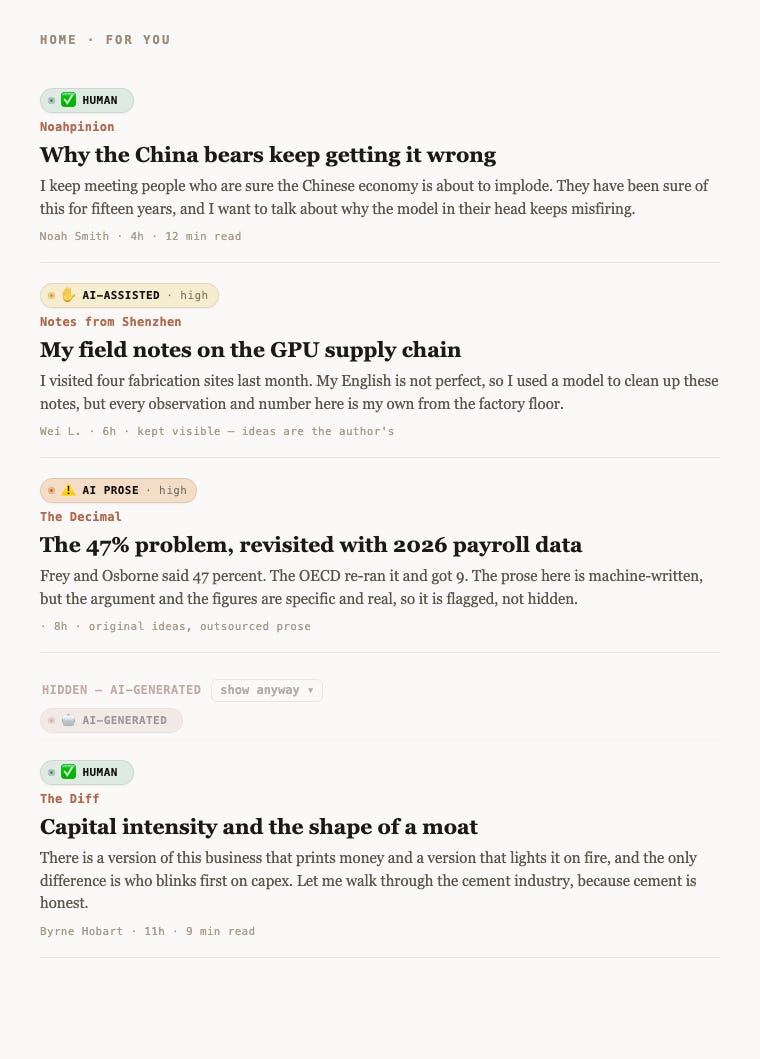
I made a browser extension for my personal use that automatically uses Pangram to scan every potential piece of writing served to me in the Substack feed. It runs this through an AI detection algorithm, and then from there makes three critical secondary judgments:
Is this person ESL and using a language model to help them sound natural in english?
Is there a chance that this is a one-off detection error, or they were busy? (aka ELO scores for writers)
How often does this person’s content get interactions from me? If I interact very often with this person, then I would like to see all of their posts, no matter what (aka exemptions)
If the piece of writing passes these judgments, then it goes into my feed. Otherwise, it’s ruthlessly consigned to the trash.


a fresh, glorious breath of air
I cannot tell you how pleasant it is to be truly liberated from slop. I know that this will not work forever, I know that the day that the slop will become tasteful is coming for us all. But in this brief and glorious moment, I am protecting my cogsec and my own writing style from the machinations of AI writing.
I fear very much the consequences of reading thousands of AI-written words every day. I’m convinced that my own writing has gotten more proximate to that universally reviled style in the last few months, as I’ve read it more and more and more.
Unlike X/Twitter, Substack is unfortunately perfectly designed to trick you into reading slop. You take writing on Substack seriously. You want to engage with it deeply, and the first paragraph often makes you expect that you’re not reading something written by Claude, Gemini, or ChatGPT. Now I no longer ever have to have the feeling again of reading something that seemed promising, only to have it devolve into god-awful slop.
It also helps China-maxxing (and reading ESL writers in general)
The ESL filter also allows me, pleasantly, to read more non-English sources, which has been a pleasant surprise. I’m still fine-tuning the ESL detection to better capture an author’s original voice and ideas while avoiding LLM flags. It’s not perfect yet, but it’s getting better and better.
You can make this for yourself in under 1h and run it for $0.55/hour of reading
Distributing something like this might be a flagrant violation of the terms of service of both Pangram and Substack, and I don’t want to make trouble. For this reason, I won’t be providing any links or submissions to the App Store for this product; it will exist on my machine and machine alone. Sadly, this also means that I won’t ever have it on mobile, but let’s face it- I could do less reading in bed on my phone.
If you’re interested in building something like this for yourself, here’s the .md file that I used for the build. I hope you can enjoy the beautiful world of slop-free Substack.
a diabolical idea I had during the making of this
obviously, seeing that Pangram is effective also made me realize that you could make this really devious and simple loop whereby:
you chat with your model of choice around a writing project
that model drafts something using a specialized Markdown file describing your voice and tenor as well as generic human-writing “markers”
that is fed into Pangram
that’s used as your verifiable reward where you loop and iterate
once you hit whatever your goal is on human-written prose, you’re done
RLVR for prose, baby. A harness for writing. Who is building this? Surely this is already a thing, right?