

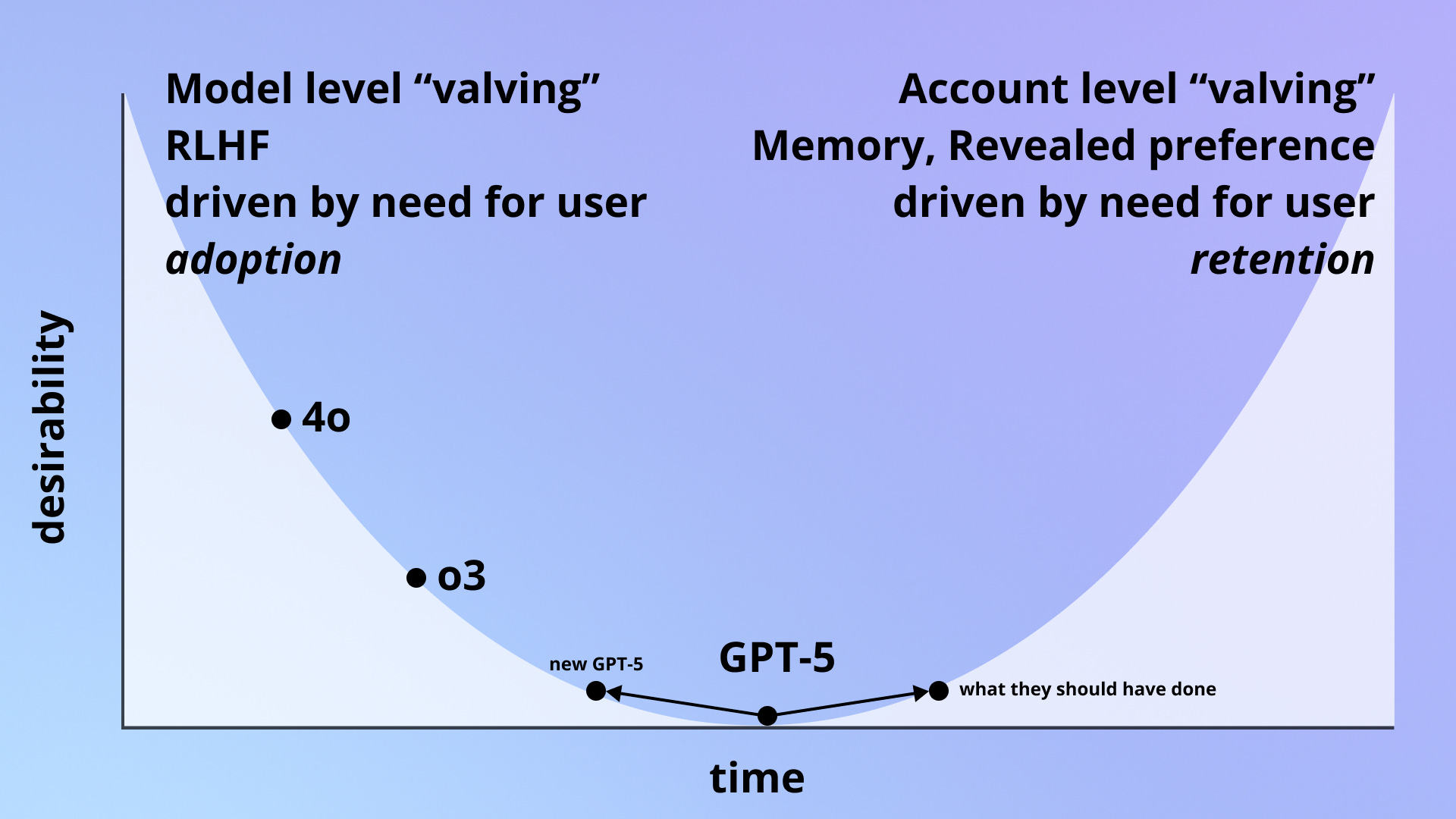
I have been listening to the excellent ‘Anthro of SF’ series by Jasmine Sun, and in the latest episode there was this BEAUTIFUL passage talking about Buckminster’s ideas of “valving” technologies.
I read it, and instantly had a kind of revelation around GPT-5 and what went so deeply wrong with the latest OpenAI launch.
He says:
Fuller had this idea of what he called the “comprehensive designer,” and he wrote about this as early as 1941. He said, “Industry is out of hand, it's disproportionate, it concentrates resources. What we need to do is take the products of mass industrial technology, valve them”—that was his word, “valve them down into our lives and use them for individual growth, individual worlds, individual improvement.” The hippies took that very much to heart. His work circulated everywhere in the hippie world, and Stewart Brand leaned on it very hard. They were very close friends. He was his first real mentor after Ken Kesey. That notion of taking industrial products and turning them into tools for individual growth, that's what we see when Apple starts marketing around 1980.
GPT-4o hit potent product-market fit: a responsive, warm, tolerant chat interface that satisfied specific emotional jobs, from brainstorming to basic comfort.
That warmth, plus the familiar chat surface, acted like a factory-installed valve. The model felt accommodating without heavy configuration, which helped adoption.
This was a Model Valve: RLHF and other techniques causing a model to be usable for “individual growth, individual worlds, individual improvement.” This is why there are hundreds of thousands of people who loved 4o- these three ideas of growth, worlds, and improvement.
Calling it a sycophant is a cheap, reductionist way of showing smug technologist superiority. “I don’t need a valved model, I want a firehose of intelligence” etc. I hated 4o, because I am in this camp where I want capability and cold, effective tooling. I am not, and you (dear reader) are very likely also not, the type who want a valve on the front of their LLM.
Great technologies, especially AI, need this valving function. 4o was great in this regard, and thats why people missed it so much.
People who love GPT-5 love it when its put to work- and that is a valve. Cursor is a valve on that intelligence. IDE’s focus the beam, put it to work.
GPT-5 Broke the Valve
GPT-5 is a very good firehose of intelligence. It does what you ask it to.
But there is no valve. The default of the model does not invite you to play, doesn’t give you back breadcrumbs of validation to keep going, and doesn’t guide you away from dead-end paths.
The lack of valving of the technology explains the massive split in the reception; if you have a valve of choice, you love it. If you don’t, you want the old one that OpenAI made for you back.
The Next Great Valve
The next year will see AI companies solve this problem durably by valving at the account level. We’ll see memory, preference, and a dozen other undiscovered techniques start to effectively valve down intelligence that currently flows through far to wide a pipe.
Sadly, OpenAI wasn’t ready to launch account valving changes, and had to revert back to their RLHF/preference model changes. I understand why this happened, but its a terrible thing to see as it will only delay the changes we so desperately need- a chance to deliver the right kind of desirability to each user, individually.
Memory is the only thing I obsess about when it comes to LLMs this year. The design space is truly massive and truly exciting.
Learning from Bucky & Brand
There’s a lot of wisdom and clear thinking in Buckminster and Brand, two writers who my friend Michael introduced me to 12 years ago. I want to support more work that brings their ideas forward to the current moment; if you know of people who are doing this, reach out.