

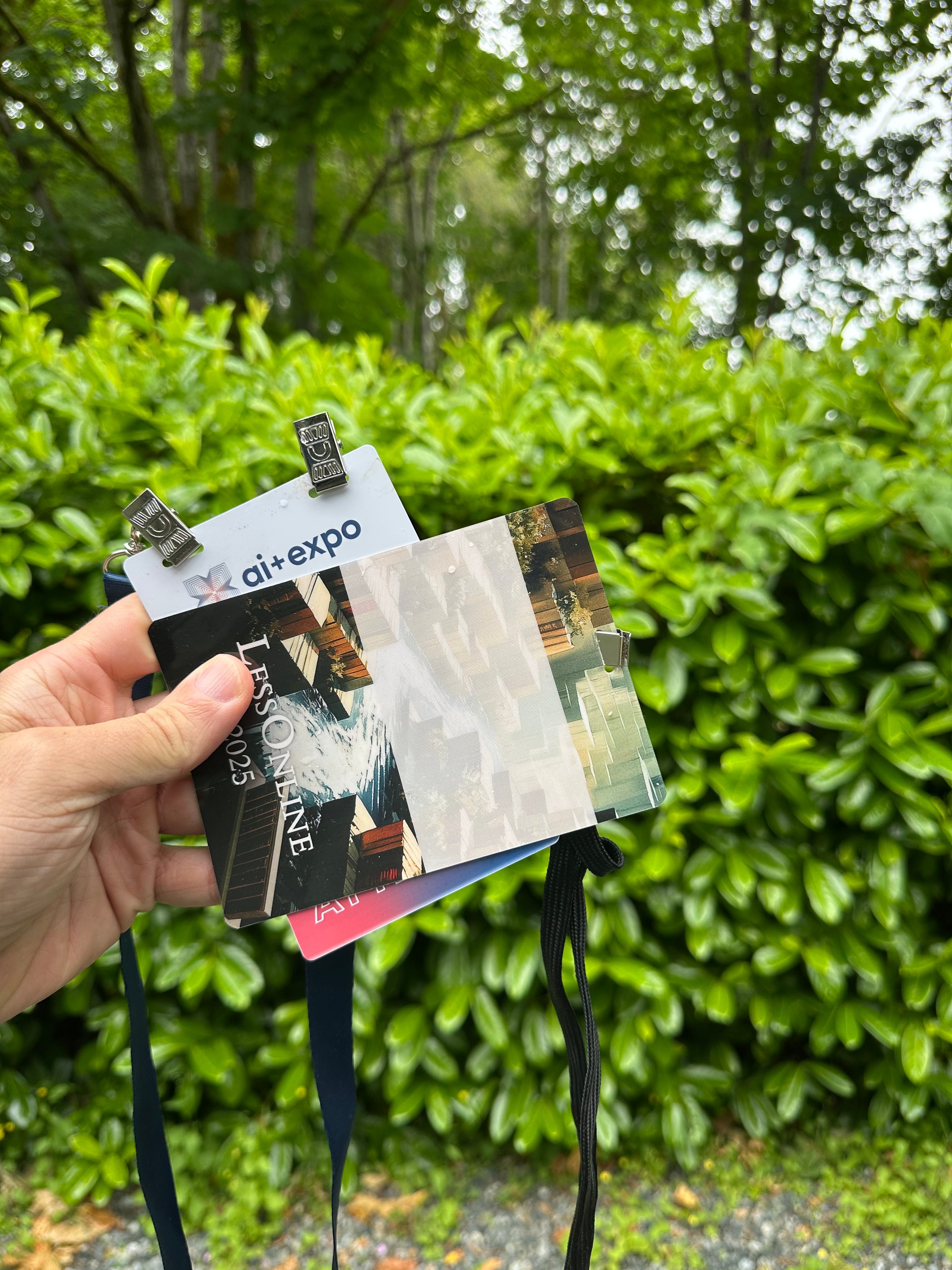
I spent one weekend at LessOnline in Berkeley and the three days that followed at the SCSP AI Expo in Washington. Same country, both ostensibly about artificial intelligence, yet the gatherings felt like excursions to non-overlapping planets. LessOnline prizes belonging; the Expo prizes persuasion. Everyone talked about steering the future away from existential harm, but the Berkeley crowd sees peril in runaway capability while Washington sees opportunity in fielding it at scale.
Both planets defend themselves with language. In Berkeley the hallway chatter orbits “p(doom),” “take-off speeds,” and the “orthogonality thesis.” In Washington the code words are JADC2, ABMS, and CMMC. Miss the dialect and the conversation evaporates. Each tongue forms a closed system, efficient inside, opaque outside, and neither side shows much appetite for translation.
The ideas presented at LessOnline were undeniably brilliant, and the people who lay about Lighthaven chatting were impressive. The organization was fucking terrible, their conference app was beyond terrible. From the bumbling hour long introduction to the lack of food, the incompetence was clear, and almost celebrated- “oh, gee, look at how we’ve fumbled this, we’re just good-hearted writers who can’t seem to get ourselves sorted out”. The first night the pitiful amount of mediocre Indian food they brought in was instantly gone and so I got to see some of the most wealthy people in the Bay Area eating shitty pizza from a greasy paper plate at a 600 dollar/ticket event. The pizza, for those curious, was corn, peaches, cheese, and some unidentifiable green vegetable. Horrifying.
The AI Expo was much less brilliant, but vastly more competent. The vibe change off a redeye was so refreshing- eye contact, competent organization, people walking with purpose. The median talk was terribly dull, and I learned so little compared to my Berkeley weekend, but this was not about learning- it was about persuasion.
China hovers like a shadow in both conversations yet rarely appears in person. AI 2027 casts a Chinese lab as the spark that turns fast take-off into a global scramble, and its name surfaced in half the Berkeley sidebars I joined. At the Expo every keynote invoked Beijing as the pacing threat, yet only one breakout was explicitly about China, and it never filled the room. The country functions as a motivation to hurry, not as a subject to understand, and certainly never as an ally in co-creating a vision for the 21st century.
The two communities share bones. Almost everyone in both rooms holds a graduate degree or left one unfinished to chase a grant or a dry-run deployment. Ideology runs thick: rationalists assume superintelligence is plausible and alignment mandatory, while defense planners treat technological superiority as first-order deterrence. Each tribe is convinced the real leverage sits where they sit- the labs in Berkeley, the purse strings in D.C., and that conviction keeps them confident and apart. I could not help but see these communities as the products of different kinds of suburban nerd childhoods. Got into debate club, and parents golf and go to church? Welcome to the AI Expo. You a Mathlete with folks who have attended a grateful dead show and own a Prius? Welcome to East Bay Rationalists Prom.
California’s animating verb was prevent; the capital’s was deploy.
A few moments crystallized the gap. Scott Alexander packed a dark night in the courtyard to riff on biblical apocalypses, his silhouette in front of slides that made the room laugh (did you know that all of the Anthropic cofounders have “names of ruination”?) . I met someone whose twitter I would describe as the most rancid vat of terrible ideas on the internet and found I liked them in person. LessOnline felt like the comment section come to life—my favourite follows and my most-blocked tweeters sharing the same little cubbies of their sun-drenched Berkeley fortress. Across the country Eric Schmidt opened an Expo panel, folding Silicon Valley optimism into defense-industrial cadence, but the atmosphere snapped back to acquisition checklists as soon as he ceded the stage.
Back-to-back attending showed how both sides lag. Washington is behind the frontier; conversations about large-language-model capability stop way before real proficiency. There are genuinely baffling products being hawked- a hardened case full of H100s that runs on batteries, so you can do RL in the field comes to mind. The gossip only underscored how little organic familiarity government buyers have with the systems themselves. Berkeley, by contrast, is behind on persuasion. MIRI’s latest strategy packet stretches past twenty thousand words of game-theoretic dread and assumes the reader already speaks the shorthand; a Senate aide would bail by page three. Both communities chase status inside their bubbles, winning digital upvotes and three-letter-agency promotions.
AI 2027 is the clearest case. If its scenario really sketches the fastest plausible acceleration, where is the twelve-page edition a legislative staffer can digest between mark-ups? Where is the glossary that turns recursive self-improvement into procurement milestones? Until someone rewrites the document for the audience that writes the laws, it will keep echoing in the choir loft. I asked 2 of the authors of this work (which I consider to be important) if they want to expand the accessibility of the piece- and was met with utter indifference.
So what now? First, AI 2027 needs a full rewrite for Washington—less prophecy, more milestones, fewer cliffs of conditional probability. Second, D.C. must chase the technological frontier rather than wait for it to clear security review; too many defense primes showcased demos that would have looked dated 10 years ago. Finally, we need deliberate overlap: someone, anyone, who splits their time between Lighthaven meet-ups and Pentagon briefings. Keeping these planets in conversation is the only way America stays the birthplace of AGI instead of its first cautionary tale.